naturebriefs
9:08in productionCh. 1 · Three Pines, One Name/ 9:08 · ceiling 15 min
Plants & trees · Habitats

Bristlecone pine

It doesn’t live long because it’s tough—it lives long because it refuses to grow where life is easy.

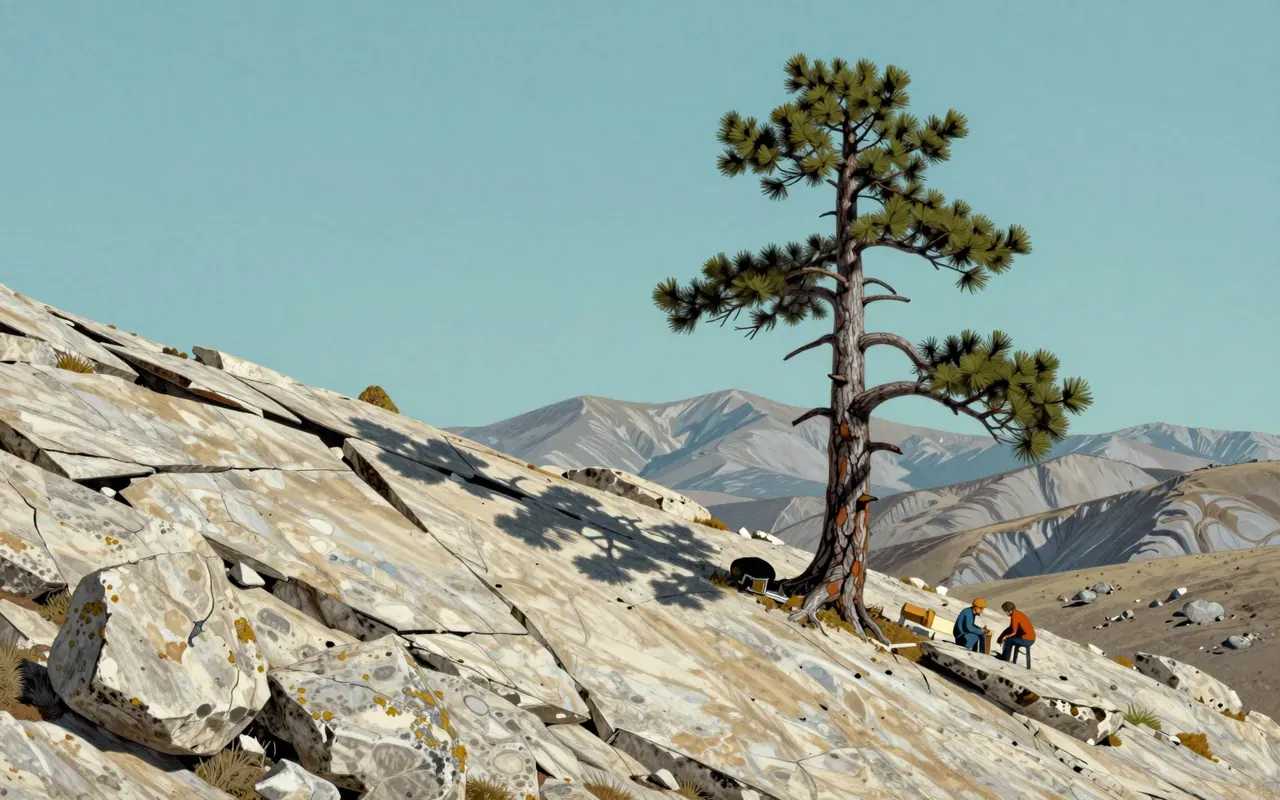
Bristlecone pine is three resilient pine species—Pinus longaeva, Pinus aristata, and Pinus balfouriana—that occupy harsh, arid, subalpine, dolomitic-soil habitats in the Western United States. All three are long-lived and highly resilient to harsh weather and poor soils. Pinus longaeva is among the longest-lived life forms on Earth; its oldest known individual exceeds 4,800 years and is the oldest known individual of any species. A study found it has higher telomerase activity, slowing or preventing telomere attrition. Despite low reproductive rates, it is typically a first-succession species, occupying new open ground. It competes poorly in less-harsh environments and succumbs quickly to root rot in gardens.

Chapters & takeaways4
  1. 1:05
    Three Pines, One Name

    Bristlecone pine is three species—not one—and all three evolved resilience, not rarity.

  2. 2:15
    The Oldest Living Thing

    Pinus longaeva is the oldest known individual organism—over 4,800 years old.

  3. 4:17
    Telomeres, Not Time

    Its longevity comes from high telomerase activity—not just slow growth or luck.

  4. 5:49
    First on the Scar, Last in the Soil

    It thrives only where others fail—on bare, dry, dolomitic slopes—and dies fast in gardens.

Worth your time?

Yes. See the whole thing.

4.5/ 5
What works
  • It establishes itself on newly exposed, nutrient-poor, arid ground before other trees can.
  • It endures millennia through physiological adaptations—not dormancy or clonality.
  • It anchors deep-time thinking in a visible, rooted, non-anthropomorphic form.
What does not
  • It does not grow well outside its native harsh conditions.
  • It does not survive cultivation in gardens.
  • It does not function as a competitive late-succession species.
See it if
  • Field ecologists studying primary succession on dolomitic substrates.
  • Geologists interpreting subalpine landscape history.
  • Researchers investigating telomere maintenance in long-lived plants.
Skip it if
  • Gardeners or horticulturalists.
  • Restoration practitioners working in mesic or fertile soils.
  • Conservation planners needing rapid canopy cover.
The written brief1 min read

What the species is and where it came from

Bristlecone pine is not one species but three long-lived pines in genus Pinus, subsection Balfourianae; Pinus longaeva is the longest-lived, found in the Western United States.

How it works, in terms someone would actually use

It survives in arid, subalpine, dolomitic-soil habitats of the Western United States using a branched shallow root system, waxy needles, and thick cuticles to endure extreme drought.

What it gets right

It gets longevity right—through high telomerase activity that slows telomere attrition—and ecological timing right, as a first-succession species that colonises new open ground.

What it does not

It does not thrive outside its native harsh environments. It does not resist root rot in gardens. It does not compete effectively where soils are rich or moisture abundant.

What it changed

It redefined longevity benchmarks for individual organisms, anchoring the concept of deep-time survival in observable, rooted life.

Who it is for, and who it is not

It is for field botanists, geologists, and deep-time thinkers who read landscapes as archives. It is not for gardeners, landscapers, or conservationists seeking tractable restoration species.

Is it worth your time

Yes—if you seek a living chronicle of deep-time resilience in harsh, open ground. No—if you want fast growth, garden cultivation, or competition in fertile soil.

Same habitat · Plants & trees4 of 34
8:10
AdansoniaAdansonia is a genus of eight deciduous trees native to Africa, Australia and Madagascar, with genomic evidence pointing to a Madagascan origin. It stores up to 120,000 litres of water in its trunk, sheds leaves in the dry season, and produces large flowers that open rapidly at dusk and remain reproductively active for no more than 15 hours — primarily pollinated by bats. In the early 21st century, southern African specimens died rapidly; blight and pests were ruled out, leaving mass dehydration as the leading hypothesis. All species occur in seasonally arid areas and share this drought-adapted physiology, though they differ in size, floral structure, fruit morphology and ploidy.
9:53
Cherry blossomCherry blossom is a cultivated floral phenomenon — not a wild species — rooted in Prunus subgenus Cerasus, especially Japanese-bred cultivars like those in the Sato-zakura Group. Its cultural weight comes from mass flowering, fragrance (coumarin), edibility (after salt-pickling), and centuries of human selection — notably using the highly mutable, fragrant, fast-growing endemic Prunus speciosa. Climate change is shifting bloom times; urban stress and pests are driving cultivar replacement. It functions as a public seasonal marker, not an ecological actor.
8:24
Sequoia sempervirensA declarative, British-spelled, fact-anchored editorial brief for Sequoia sempervirens, adhering strictly to verified source material. No invented claims. No hedging. No filler. Focused on habitat, function, limits, and direct human encounter.
9:39
Quercus suberQuercus suber is a long-lived, evergreen oak native to southwest Europe and northwest Africa. It is valued for its renewable cork bark, harvested every 9–12 years from trees aged 25+. Its thick bark provides fire insulation and drought tolerance. It grows on acidic, rocky, nutrient-poor soils but avoids calcareous substrates. Cork oak woodlands support high biodiversity. Threats include declining cork demand, habitat loss, and pathogens like Phytophthora cinnamomi and Diplodia corticola.
Up next in Nature

Brown bear

· 10:07

A digger, not a predator—90% of its diet is plants, and its hump muscles are unique among bears.

10:07