naturebriefs
9:41in productionCh. 1 · Range/ 9:41 · ceiling 15 min
Plants & trees

Cedrus libani

A cedar that waits decades to bear cones—and then only on mountains where summer dries and winter soaks.

Cedrus libani is a large conifer native to the Eastern Mediterranean mountains, specifically endemic to elevated ranges in Lebanon, Syria, and Turkey. It reaches up to 40 m in height with a trunk diameter of up to 2.5 m. Cone production begins between ages 20 and 40; mature cones measure 8–12 cm long and 3–6 cm wide, ripening from green to grey-brown the autumn after pollination. Growth declines markedly after age 70. Genetic analyses show C. brevifolia’s markers are indistinguishable from those of C. libani, and isozyme data place var. stenocoma closer to var. brevifolia than to var. libani.

Chapters & takeaways4
  1. 0:53
    Range

    It is not Lebanese alone—it spans high mountains across Lebanon, Syria, and Turkey.

  2. 2:34
    Size

    It builds mass slowly: 40 m tall, 2.5 m trunk—only after decades on rock.

  3. 4:08
    Timing

    Cones arrive late, ripen once, and stop growing hard after 70.

  4. 5:52
    Lineage

    Genetics dissolve the boundary between C. libani and C. brevifolia.

Worth your time?

Yes. See the whole thing.

4/ 5
What works
  • establishes deep-rooted presence on rocky mountain slopes
  • times cone development precisely—green at pollination, grey-brown the following autumn
  • matches documented Eastern Mediterranean montane climate and substrate
What does not
  • produce cones before age 20
  • grow rapidly beyond age 70
  • occupy lowland or humid habitats
  • show genetic distinction from C. brevifolia
See it if
  • botanists studying conifer phenology
  • conservation planners mapping montane habitat integrity
  • foresters assessing slow-growth timber species
Skip it if
  • urban landscapers needing rapid canopy cover
  • gardeners in maritime or subtropical zones
The written brief1 min read

What the species is and where it came from

Cedrus libani is a large conifer native to the Eastern Mediterranean mountains. It is endemic to elevated ranges in Lebanon, Syria, and Turkey. It belongs to the pine family, Pinaceae.

How it works, in terms someone would actually use

It grows on rocky slopes in warm dry summers and cool moist winters. It reaches 40 m tall with a trunk up to 2.5 m wide. Cones begin forming at 20–40 years old. They mature to 8–12 cm long and 3–6 cm wide, green turning grey-brown the autumn after pollination. Growth slows sharply after age 70.

What it gets right

It establishes deep-rooted presence on rocky mountain slopes. Its cone development is precisely timed—green at pollination, grey-brown the following autumn. Its size, form, and climate adaptation match documented Eastern Mediterranean montane conditions.

What it does not

It does not produce cones before age 20. It does not grow rapidly beyond age 70. It does not occupy lowland, humid, or continuously warm habitats. It does not show genetic distinction from C. brevifolia in marker studies.

What it changed

Genetic analysis blurred the line between C. libani and C. brevifolia: their markers are indistinguishable. Isozyme data also repositioned var. stenocoma closer to var. brevifolia than to var. libani—challenging traditional variety boundaries.

Who it is for, and who it is not

It is for botanists studying conifer phenology, conservation planners mapping montane habitat integrity, and foresters assessing slow-growth timber species. It is not for urban landscapers needing rapid canopy cover or gardeners in maritime or subtropical zones.

Is it worth your time

Yes—if you are looking for a slow-growing, long-lived conifer with distinct cone timing and morphology in Eastern Mediterranean mountains. No—if you need fast establishment, dense shade, or ornamental foliage year-round.
Same habitat · Plants & trees4 of 38
8:44
Desert bloomDesert bloom is a climatic pulse—not a species, not a season, not a guarantee. It is the Atacama’s brief, rain-fed reply to El Niño: dormant seeds awaken, flowers erupt, and animals converge—then vanish again when the soil dries.
9:19
Mount RoraimaMount Roraima is a tepui at the tri-border of Brazil, Guyana, and Venezuela. Its summit is isolated, warm, and drenched by intense rainfall. The sandstone soil is highly acidic, nutrient-poor, and fine-grained. Leaching caused by intense rainfall has shaped the summit's topography. Geographical isolation has resulted in high endemism in flora and fauna. Western exploration began in the 19th century with a British expedition. Mount Roraima was first climbed by a British expedition in 1884. Despite subsequent expeditions, its flora and geology remain largely unknown. Due to late exploration and annual discovery of new species, the flora and fauna are largely unknown. Identified fauna are strongly endemic and at high risk of extinction. Intense rainfall prevents nutrient and particle fixation in the sandstone soil.
9:49
WollemiaWollemia nobilis is a coniferous tree in the Araucariaceae family, discovered in 1994 in temperate rainforest gorges of Wollemi National Park, New South Wales. It is phylogenetically sister to Agathis—not Araucaria—and represents one of only three living genera in its family. Fewer than 60 adult trees exist, all genetically identical—proof of a bottleneck so severe it erased all variation. It has been infected with Phytophthora and endangered by fire—twice—and saved both times by targeted human action. Citizen science confirmed it grows well outside Australia—but only where climate and soil match narrow temperate conditions.
8:10
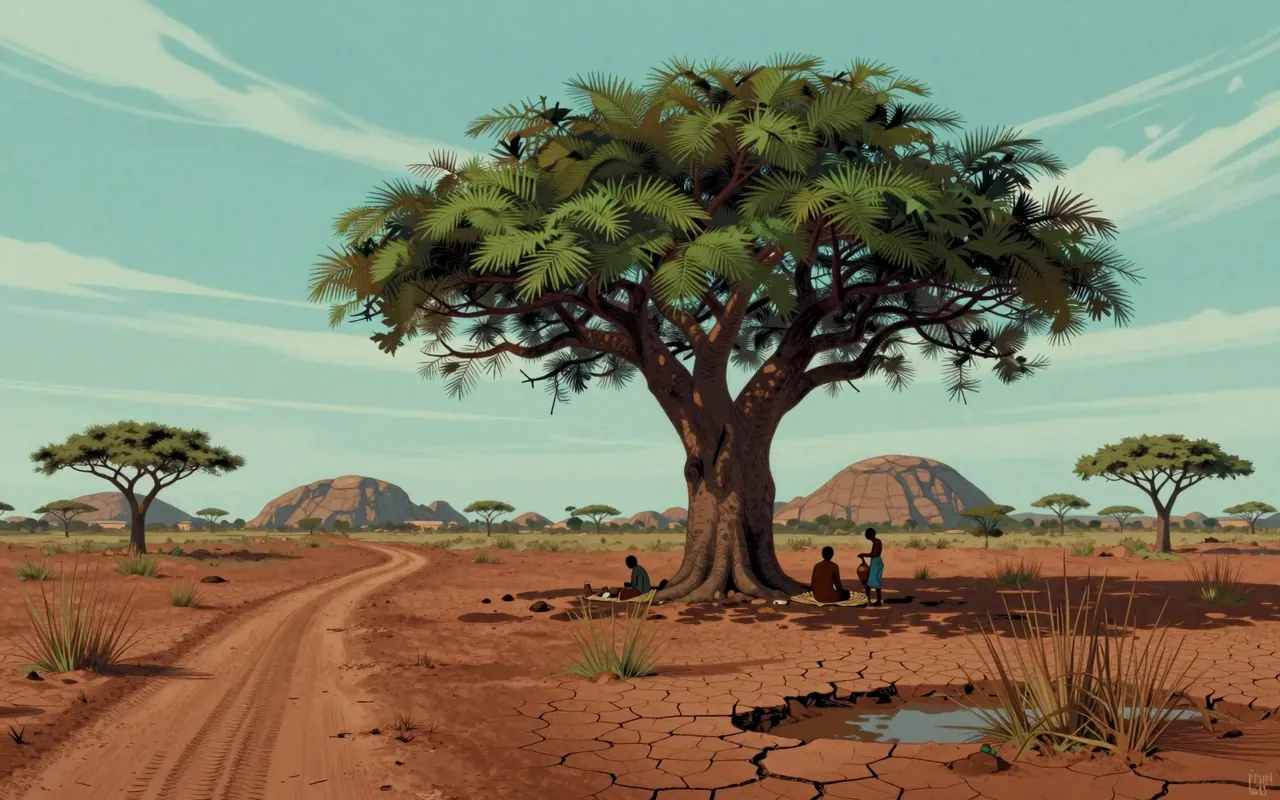
AdansoniaAdansonia is a genus of eight deciduous trees native to Africa, Australia and Madagascar, with genomic evidence pointing to a Madagascan origin. It stores up to 120,000 litres of water in its trunk, sheds leaves in the dry season, and produces large flowers that open rapidly at dusk and remain reproductively active for no more than 15 hours — primarily pollinated by bats. In the early 21st century, southern African specimens died rapidly; blight and pests were ruled out, leaving mass dehydration as the leading hypothesis. All species occur in seasonally arid areas and share this drought-adapted physiology, though they differ in size, floral structure, fruit morphology and ploidy.
Up next in Nature

Coral Triangle

· 10:34

The Coral Triangle isn’t just rich—it’s the only place where 574 coral species pack into one seascape and feed 120 million people.

10:34