8:29in productionCh. 1 · How many, where, and what they’re known for/ 8:29 · ceiling 15 min
Reptiles & amphibians · Evolution
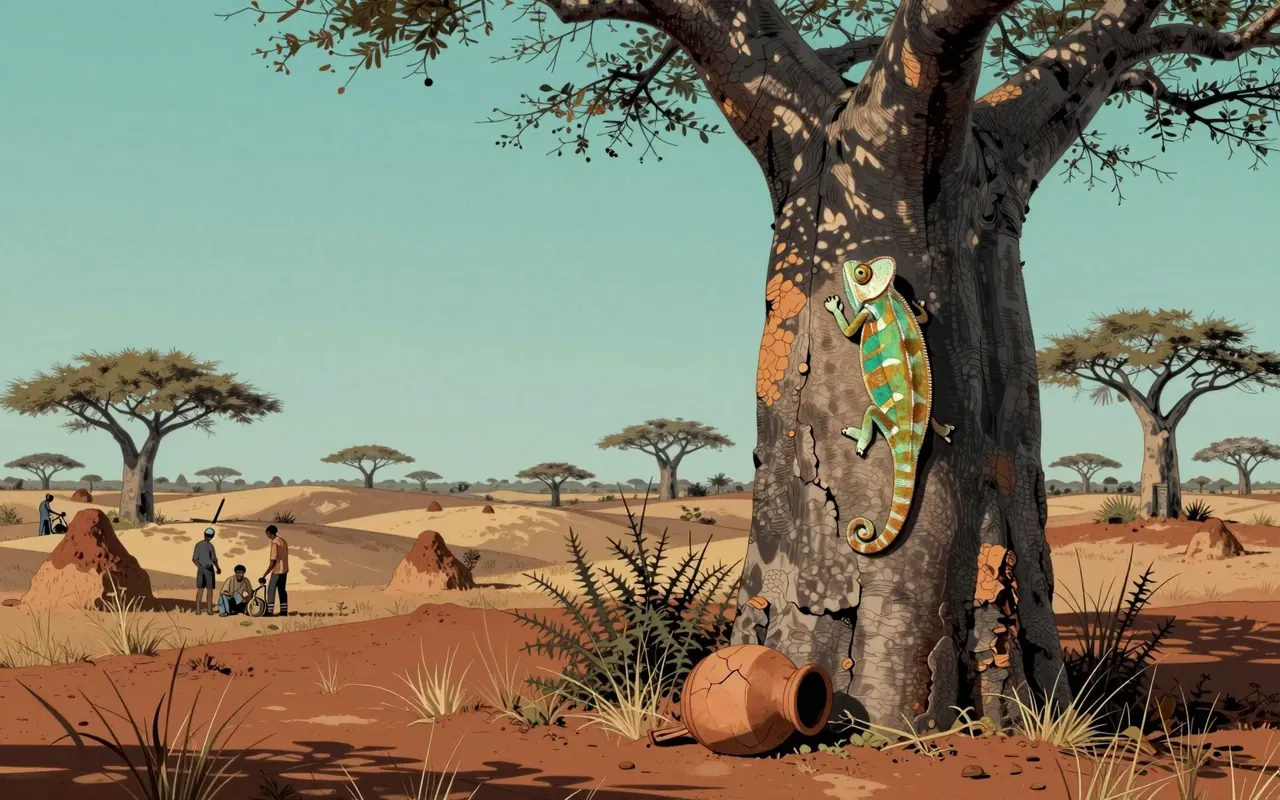
Chameleon
Chameleons don’t change colour to hide — they run live optical interference experiments on their own skin.
Chameleons are a reptile family with 200 described species as of June 2015. They inhabit sub-Saharan Africa and Madagascar, ranging from rainforest to desert. They are predominantly insectivorous, though larger species eat small vertebrates. Their colour change is mediated by layered dermal chromatophores — especially two iridophore layers containing guanine nanocrystals — and serves camouflage, social signalling, thermoregulation, and predator-specific responses. Colour change capacity varies across species: some shift only brightness, others display vivid multicolour combinations. Many species are threatened, largely due to habitat loss.
200 chameleon species were formally described by June 2015 — and all share the same core optical mechanism.
2:20
The skin is a photonic stack
Their skin is a stack of optical cells — yellow/red pigment cells, two iridophore layers, and black melanin cells — not a single ‘colour-changing’ layer.
3:50
Two layers, two jobs
Two iridophore layers control colour: one fine-tunes visible light, the other reflects heat — making colour change thermally coupled.
4:53
No universal palette
Some chameleons shift only brown tones; others flash reds, yellows, greens, and blues — variation is the rule, not the exception.
Chameleons are a lizard family (Chamaeleonidae) with 200 formally described species as of June 2015. They occur mainly in sub-Saharan Africa and Madagascar. Their habitats range from rainforest to desert. They are predominantly insectivorous, though larger species consume small vertebrates.
How it works, in terms someone would actually use
Chameleon colour change works via two superimposed iridophore layers in the skin — one with small guanine nanocrystals in a triangular lattice, the other with larger crystals reflecting near-infrared light — modulating reflected wavelengths through structural interference.
What it gets right
It gets right the layered dermal architecture: xanthophores and erythrophores (yellow/red), iridophores (structural blue/green), and melanophores (darkening control) — all physically verified.
What it does not
It does not shift colour for deception alone. It shifts for camouflage, social signalling, thermoregulation, and predator-specific responses — not for ‘blending in’ as a universal rule.
What it changed
It changed how we understand vertebrate skin as an active optical system, not just pigment storage.
Who it is for, and who it is not
It is for field biologists, optics students, and evolutionary physiologists. It is not for casual wildlife watchers expecting constant, dramatic hue shifts — many species only shift brightness.
Is it worth your time
Yes — if you want to see real-time optical physics in living tissue, not just read about it.