11:56in productionCh. 1 · Origin/ 11:56 · ceiling 15 min
Birds
Great horned owl
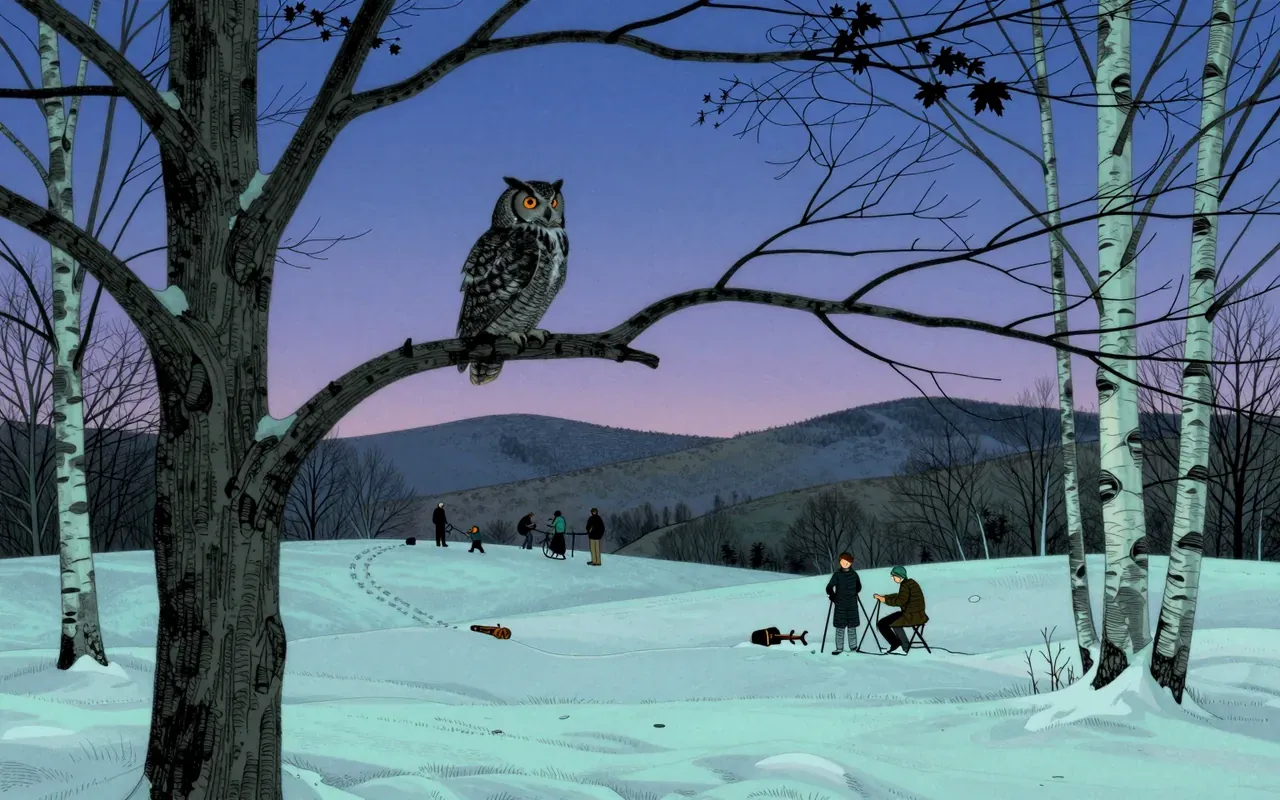
The great horned owl doesn’t wait for spring—it owns winter, and it eats skunks.
The great horned owl is a large native American owl with the widest distribution of any true owl in the Americas. Its diet centres on lagomorphs and rodents, and it uniquely preys regularly on skunks. Key physiological adaptations include silent flight enabled by specialised wing feathers, asymmetrical ear placement for precise sound triangulation, and large, cylindrical eyes optimized for nocturnal vision. The species exhibits high territorial fidelity, early breeding, and extreme morphological variation across more than fifteen recognised subspecies, with size and colour following Bergmann’s and Gloger’s rules. It inhabits an exceptionally broad range of biomes—from subarctic tundra to tropical rainforest—and faces primarily human-related mortality today, though it is not globally threatened per the IUCN.
It is the most widespread true owl in the Americas—and was named in 1788 from a 1747 English illustration.
2:32
Niche
It shares its ecological role with the Eurasian eagle-owl and the red-tailed hawk—by night and by day.
4:05
Timing
It nests earlier than almost any other raptor in North America—often in deep winter.
5:36
Diet
It eats rabbits, rats, voles—and skunks, a prey few predators touch regularly.
6:52
Range
It lives everywhere: tundra, desert, rainforest, suburbs, cities.
7:57
Design
Its adaptations—silent flight, asymmetrical ears, nocturnal eyes—are tools for one job: dominating the dark.
Worth your time?
Yes. See the whole thing.
4.5/ 5
What works
It works because it occupies space no other owl fills so completely.
It works because its adaptations are observable, testable, and tied directly to survival.
It works because its range and diet make it a living map of American ecology.
What does not
It does not rely on conservation status for relevance.
It does not need human intervention to persist.
It does not conform to expectations of avian fragility.
See it if
For field naturalists who watch behaviour, not checklists.
For students of sensory adaptation in predators.
For anyone who has heard a hoot in January and paused.
Skip it if
Those seeking endangered species narratives.
Those who only engage with birds in spring migration.
Those who assume ‘owl’ means ‘elusive’ or ‘vulnerable’.
The written brief1 min read
What the species is and where it came from
A large native American owl, formally described in 1788 by Gmelin from George Edwards’s 1747 illustration. It ranges across the Americas—from subarctic tundra to tropical rainforest—and is the most widely distributed true owl on the continent.
How it works, in terms someone would actually use
It hunts at night using silent flight, asymmetrical ears for pinpoint sound location, and large cylindrical eyes for low-light vision. It nests early, often before other raptors, and holds territory year-round.
What it gets right
It gets adaptation right: fifteen subspecies vary predictably in size and colour across latitude and humidity (Bergmann’s and Gloger’s rules). It gets timing right: breeding in midwinter gives its young a head start on spring prey. It gets sensory design right: silent flight and directional hearing are observable, functional, and unmatched among American owls.
What it does not
It does not avoid human-altered landscapes. It does not require old-growth forest or undisturbed wilderness. It does not limit itself to small prey—it takes skunks, herons, and even other raptors—but it does not eat fish, fruit, or carrion as regular parts of its diet.
What it changed
It redefined what an owl could be in the Americas: not a specialist, but a generalist apex predator occupying the same niche as the Eurasian eagle-owl and overlapping daily with the red-tailed hawk.
Who it is for, and who it is not
It is for birders who track behaviour, not just plumage; for ecologists studying niche overlap; for anyone who has heard a deep hoot at dusk and wondered what kind of animal owns the dark. It is not for those seeking rarity, fragility, or narrow endemism.
Is it worth your time
Yes—if you want to see a top nocturnal predator that thrives where few owls can: from tundra to rainforest, city edges to remote wilderness. It is not rare, but it is rarely seen well.