9:50in productionCh. 1 · Stitching with Silk/ 9:50 · ceiling 15 min
Insects & invertebrates · Systems
Weaver ant
They stitch leaves with baby silk—and run entire tree canopies like a standing army.
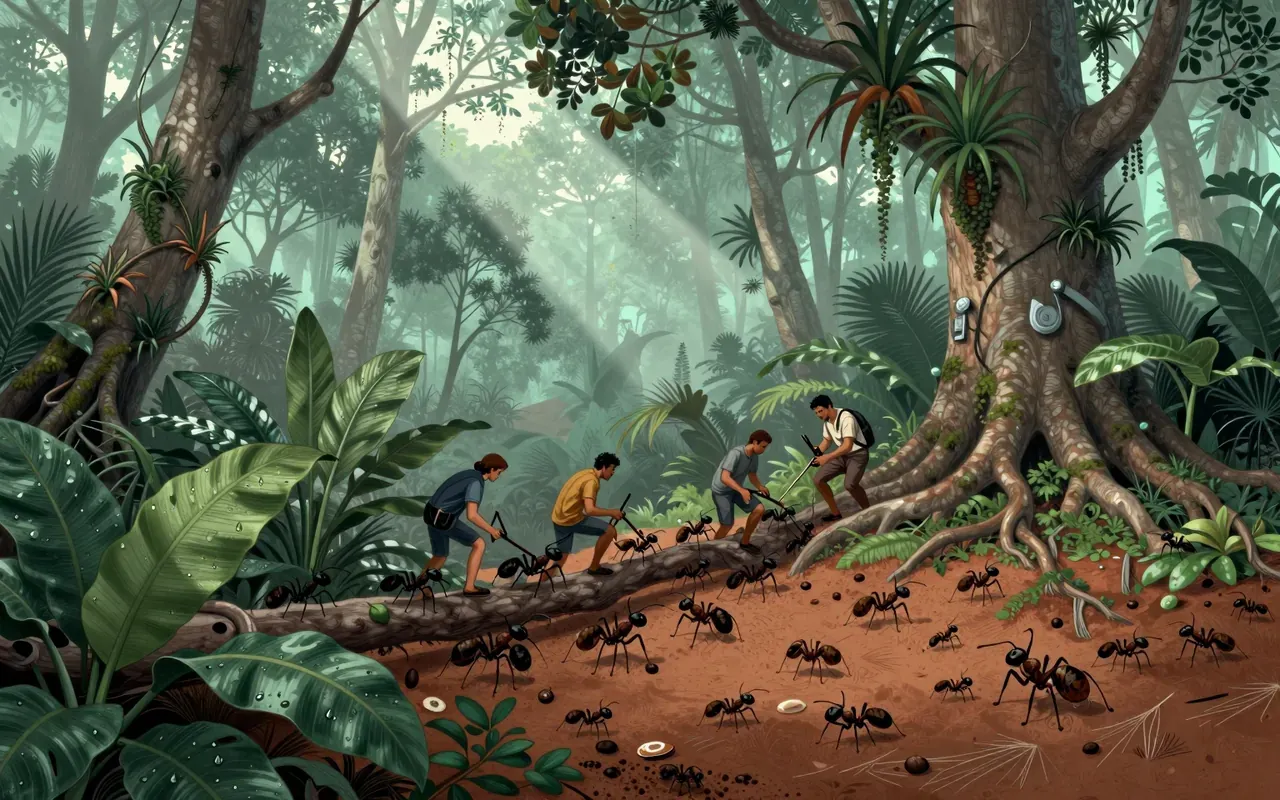
Weaver ants are obligately arboreal eusocial insects in the genus Oecophylla, found in tropical and subtropical regions—especially southeast Asia—where they live exclusively in trees. Colonies can contain more than half a million workers across hundreds of nests spanning multiple trees. Workers construct nests by weaving leaves together using silk secreted by larvae. Major and minor workers show a clear bimodal size distribution and strictly divided roles: majors forage, defend, maintain, and expand; minors care for brood and milk scale insects for honeydew. They prey on small insects and aggressively defend territory. Though lacking a sting, they inflict painful bites and spray formic acid directly at the wound. Indigenous farmers in southeast Asia use them as natural biocontrol agents against agricultural pests.
They sew leaves together using silk produced by their own larvae.
2:03
Two Sizes, Two Jobs
Major and minor workers perform strictly separate tasks—no overlap, no exceptions.
3:01
Half a Million Soldiers
Colonies exceed half a million workers and defend territory with coordinated aggression.
3:48
Biocontrol in Action
Farmers in southeast Asia deploy them as living pest control—not theory, but practice.
5:08
Diet and Design
They eat small insects and honeydew—and their bodies prove evolution sorted them into two clear size classes.
6:08
Bite and Burn
No sting—but a bite plus targeted formic acid spray delivers real deterrence.
Worth your time?
Yes. See the whole thing.
4.5/ 5
What works
territorial defence
division of labour
nest construction
What does not
sting
live on ground
build in soil or man-made structures
forage alone
See it if
ecologists studying collective behaviour
agroecologists testing biocontrol
naturalists scanning tree canopies
Skip it if
casual garden observers
indoor entomologists
anyone expecting ground-dwelling ants
The written brief1 min read
What the species is and where it came from
Weaver ants are obligately arboreal eusocial insects in the genus Oecophylla. They are found in tropical and subtropical regions, especially in southeast Asia, where they live exclusively in trees.
How it works, in terms someone would actually use
Weaver ants build nests by pulling leaves together and stitching them with silk from their larvae. Major workers forage, defend, and expand the colony. Minor workers stay inside to tend brood and milk scale insects for honeydew. They bite and spray formic acid when threatened.
What it gets right
They get territorial defence right: aggressive, persistent, and effective against insect pests. They get division of labour right: major and minor workers have non-overlapping roles and sizes. They get nest construction right: durable, multi-leaf, larval-silk-sewn shelters high in trees.
What it does not
They do not sting. They do not live on the ground. They do not build nests in soil, hollows, or man-made structures. They do not forage alone or act without multimodal communication.
What it changed
They changed how some farmers manage pests—using live colonies instead of pesticides—especially in southeast Asia.
Who it is for, and who it is not
They are for ecologists studying collective behaviour, agroecologists testing biocontrol, and naturalists who scan tree canopies. They are not for casual garden observers, indoor entomologists, or anyone expecting ground-dwelling ants.
Is it worth your time
Yes—if you want to see coordinated, large-scale insect engineering in action. Their nests are visible, their behaviour observable, and their impact on trees and pests measurable without specialist tools.