naturebriefs
10:18in productionCh. 1 · Ongoing, not past/ 10:18 · ceiling 15 min
Extinction

Holocene extinction

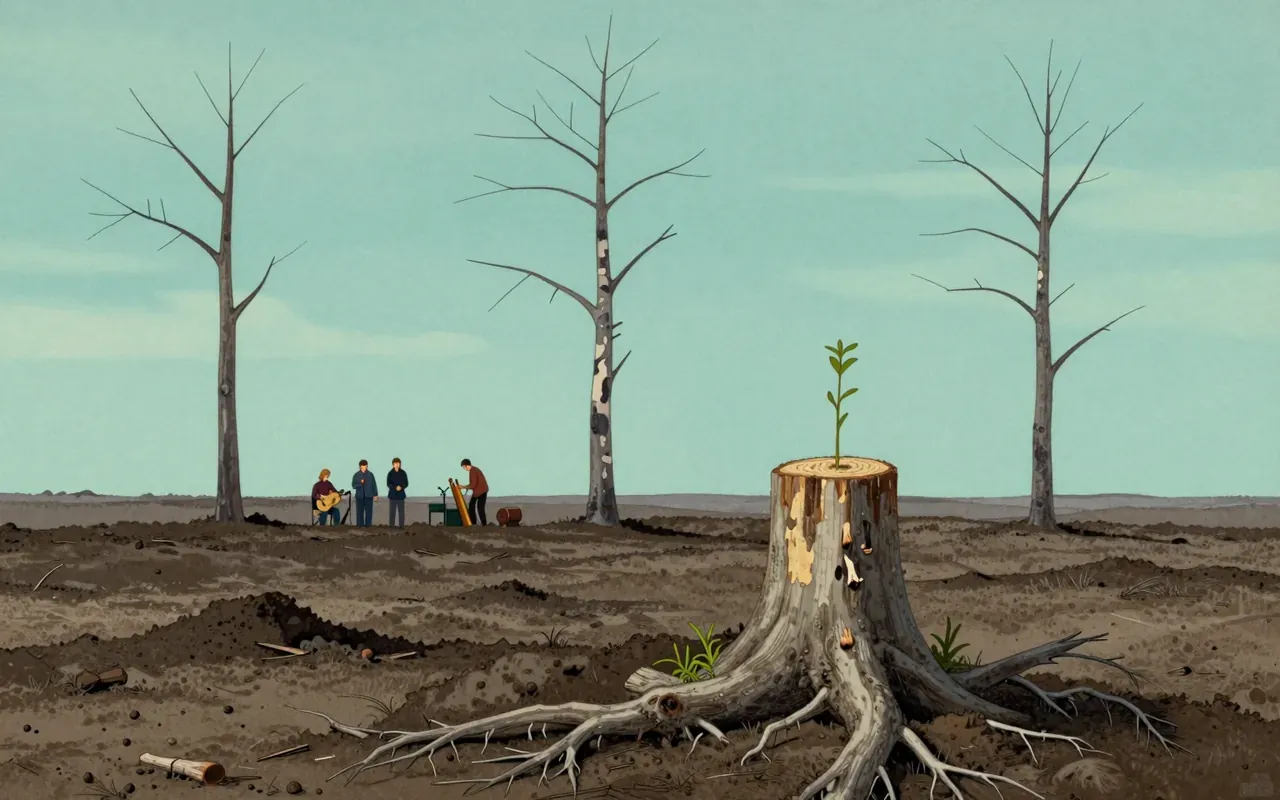
This is not an extinction event — it is the erasure of life’s diversity by human systems, measured in multiples of natural loss.

The Holocene extinction is not a species, era, or completed event. It is the empirically observed acceleration of species loss — 100–1,000× background rates — driven by human systems. It names causes, cites consensus, and rejects natural explanation. It stops where evidence stops: before declaring mass extinction status, before assigning totals, before fixing dates.

Chapters & takeaways6
  1. 0:58
    Ongoing, not past

    It is not ancient history — it is happening now, across every major group of plants and animals, on land and in the sea.

  2. 1:46
    The speed is measurable

    Extinction is running 100–1,000 times faster than normal — and plants alone are vanishing at 100× the background rate.

  3. 3:21
    The causes are named and active

    Deforestation, overfishing, ocean acidification, and wetland destruction are not abstract threats — they are documented drivers.

  4. 4:19
    The consensus is old and robust

    70% of biologists acknowledged it in 1998 — this is not speculation, but consensus among working scientists.

  5. 5:34
    It has predecessors

    It follows earlier human-driven pulses — Late Pleistocene and Polynesian — making it part of a longer arc of anthropogenic loss.

  6. 6:48
    The label is contested, not the cause

    We cannot yet compare it precisely to past mass extinctions — fossil record gaps prevent definitive paleontological ranking.

Worth your time?

Yes. See the whole thing.

4.5/ 5
What works
  • quantifies current extinction acceleration
  • names concrete anthropogenic drivers
  • cites empirical consensus (1998 survey)
  • links to earlier human-driven pulses
What does not
  • define a species
  • specify total extinctions
  • declare formal mass extinction status
  • assign precise onset date
See it if
  • conservation practitioners
  • policy makers
  • ecologists
Skip it if
  • readers seeking biological entities
  • those expecting historical closure
The written brief1 min read

What the species is and where it came from

It is not a species. It is a documented pattern of species loss — ongoing, anthropogenic, cross-taxonomic, and global — first named in reference to the Holocene epoch but continuing into the 21st century.

How it works, in terms someone would actually use

It is not a species. It is an ongoing, human-caused collapse in global biodiversity — measurable in extinction rates, driven by habitat loss, climate change, overexploitation, pollution, and invasive species.

What it gets right

It correctly identifies human activity as the sole driver of current extinction acceleration. It quantifies the rate increase (100–1,000× background). It names concrete drivers: deforestation, overfishing, ocean acidification, wetland destruction, climate change, population growth, and consumption.

What it does not

It does not name a single organism. It does not define a geological boundary. It does not specify total species lost. It does not assign exact dates to onset or declare formal mass extinction status.

What it changed

It changed the baseline for extinction science: from studying past losses to tracking real-time collapse across all major taxonomic groups, terrestrial and marine.

Who it is for, and who it is not

It is for ecologists, conservation practitioners, policy makers, and educators who must act on observed extinction dynamics. It is not for readers seeking a biological entity, a historical period marker, or a resolved scientific verdict on mass extinction classification.

Is it worth your time

Yes — if you need to understand why species are vanishing now, at scale, and what mechanisms are responsible. No — if you expect a discrete event with start date, endpoint, or taxonomic identity.
Same habitat · Extinction4 of 6
8:19
Insular dwarfismInsular dwarfism is a rapid, natural evolutionary response to isolation and scarcity — shrinking large animals across generations in islands, caves, oases and other fragmented habitats. It is documented in Pleistocene dwarf elephants and Mesozoic dinosaurs Europasaurus and Magyarosaurus. It operates via selective survival of smaller individuals, reproductive advantages of smaller size, and — in the tropics — improved thermoregulation. It is distinct from artificial dwarfing. It forms part of Foster’s rule, where large species shrink and small ones grow on islands. It evolved up to 30× faster than body-size increases.
9:22
Batrachochytrium dendrobatidisBatrachochytrium dendrobatidis is a chytrid fungus that causes chytridiomycosis in amphibians. It infects keratinized skin. It disrupts osmotic regulation. This leads to cardiac arrest. Its zoospores are motile, chemotactic, and travel one to two centimetres. It thrives between 4–25 °C. Growth halts above 28 °C. It is found worldwide—from lowland forests to cold mountain tops. It has devastated amphibian populations since its 1998 discovery. It contributed to extinctions in the Holocene extinction. Some amphibians resist infection via symbiosis with Janthinobacterium lividum. Surviving populations may reflect evolutionary selection. It also infects crayfish—but not mosquitofish.
10:16
Cretaceous–Paleogene extinction event6600 BCThe Cretaceous–Paleogene extinction event was a sudden, global geophysical shock—not a slow decline. Its evidence is physical, layered, and measurable: iridium, granite, gypsum absence, acidified oceans. It changed nothing about evolution’s rules—but everything about which lineages got to play by them.
10:02
Island gigantismIsland gigantism is a well-documented evolutionary response to island isolation—predictable, mechanistic, and fatal when humans arrive.
Up next in Nature

Autumn leaf color

· 9:29

Autumn leaf colour is not decay—it’s a metabolic pivot, timed to light and cold, that turns leaves into temporary solar shields and insect warning signs.

9:29