9:08in productionCh. 1 · What it is/ 9:08 · ceiling 15 min
Reptiles & amphibians
Green iguana
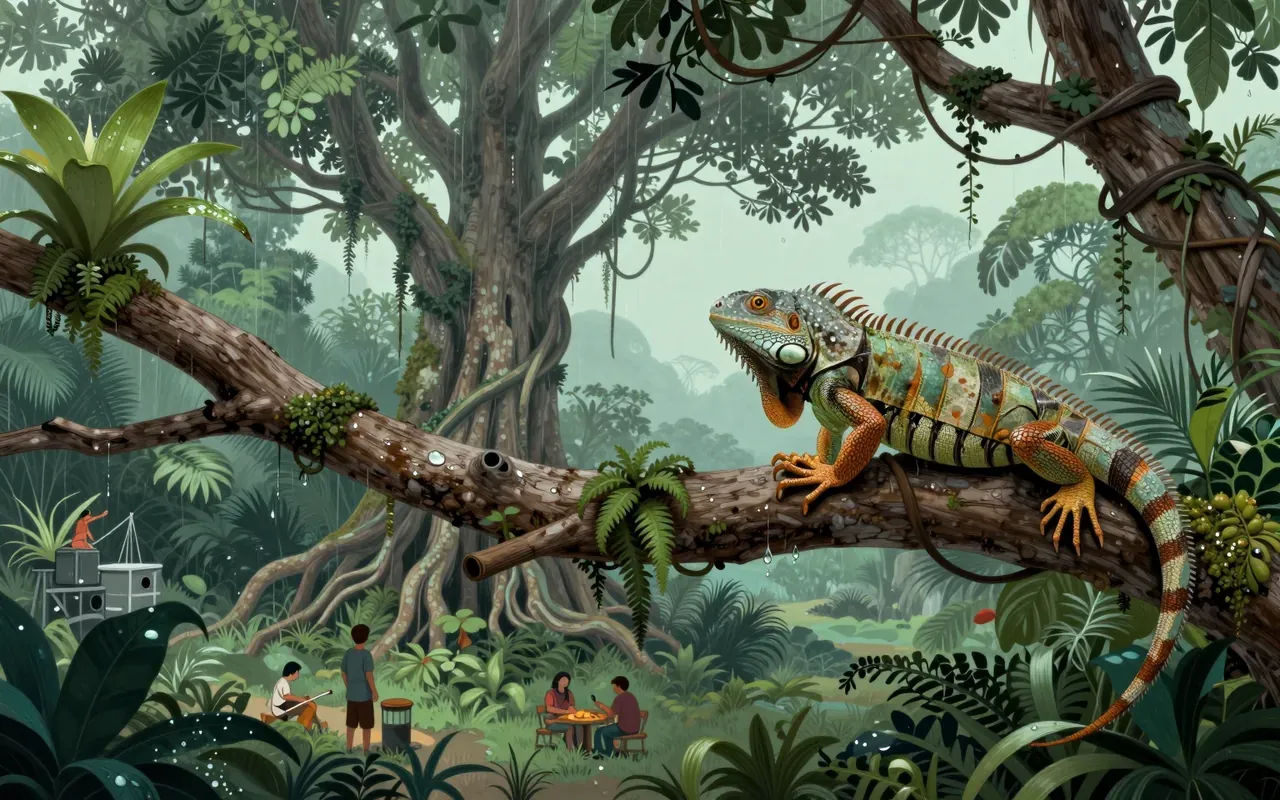
A hurricane washed it to Anguilla—proving this lizard sails the Caribbean on storm debris.
The green iguana is a large, arboreal, mostly herbivorous lizard native from southern Brazil and Paraguay to Mexico. It originated in South America and radiated through Central America and the Caribbean. Its herbivorous diet drove adaptations in locomotion and osmoregulation. Genetic studies using nuclear and mitochondrial DNA from 17 countries confirm deep lineage divergence but no unique mitochondrial haplotypes supporting subspecific status. The 1995 Anguilla colonisation event provides direct evidence of oceanic dispersal. Conservation status is IUCN Least Concern, though overhunting has caused local declines and habitat depletion is noted as a future concern.
It is a large, tree-dwelling herbivore native from southern Brazil to Mexico.
2:05
How it works
Its herbivory shaped its locomotion and salt-handling physiology.
3:05
Where it came from
DNA from 17 countries confirms a South American origin and deep splits—but no subspecies.
4:20
What taxonomy got wrong
Mitochondrial data invalidated the Central American subspecies I. i. rhinolopha.
5:35
How it crosses oceans
In 1995, it colonised Anguilla after a hurricane—direct proof of oceanic dispersal.
Worth your time?
Yes. See the whole thing.
3.5/ 5
What works
osmoregulation
oceanic dispersal
herbivorous adaptation
What does not
support subspecies distinctions
show stable regional taxonomy
exhibit predictable population trends outside local contexts
See it if
field biologists tracking lineage divergence
conservationists monitoring local overhunting
ecologists studying oceanic dispersal
Skip it if
anyone seeking clear taxonomic boundaries
anyone expecting stable subspecies
The written brief1 min read
What the species is and where it came from
The green iguana is a large, arboreal, mostly herbivorous lizard native from southern Brazil and Paraguay to Mexico. It originated in South America and spread north through Central America and the Caribbean.
How it works, in terms someone would actually use
It climbs trees to feed on leaves and flowers. It regulates salt and water efficiently because it eats plants. It disperses across oceans when swept offshore by storms.
What it gets right
It gets osmoregulation right: its herbivorous diet drove precise physiological adaptations for processing plant-based salts and water.
What it does not
It does not support subspecies distinctions. Mitochondrial DNA shows no unique haplotypes for Central American or Caribbean populations.
What it changed
It changed how biologists view iguana dispersal: the 1995 Anguilla colonisation proved oceanic rafting is viable for large reptiles.
Who it is for, and who it is not
It is for field biologists tracking lineage divergence, conservationists monitoring local overhunting, and ecologists studying oceanic dispersal. It is not for anyone seeking clear taxonomic boundaries or stable subspecies.
Is it worth your time
Yes—if you want to see a large, arboreal lizard that crossed the Caribbean Sea on floating debris after a hurricane.