naturebriefs
10:40in productionCh. 1 · Range/ 10:40 · ceiling 15 min
Mammals · Habitats

Polar bear

A seal-hunting ice-walker built like no other bear — but don’t mistake its adaptations for versatility.

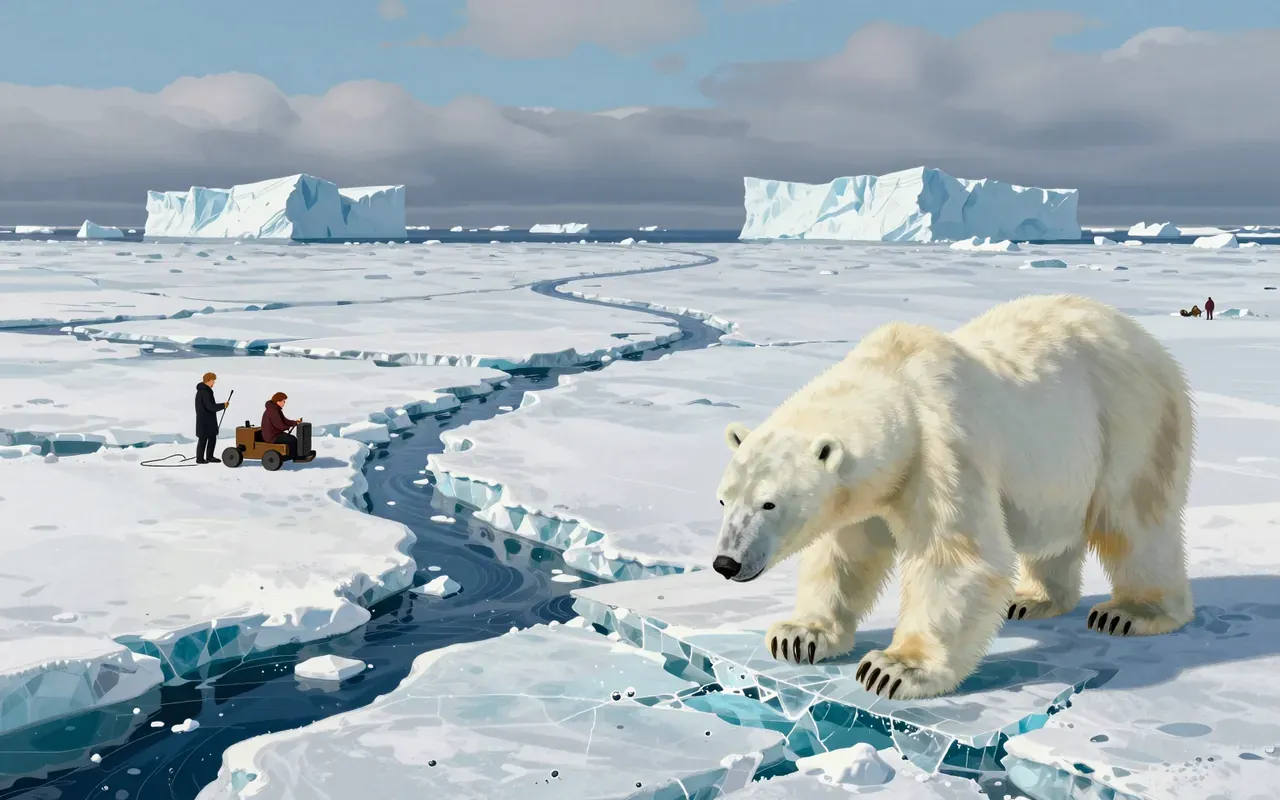
The polar bear is a seal-specialist predator adapted to Arctic sea ice. Its verified traits — size, dimorphism, fur, skin, fat, paws, teeth, skull shape — all serve ice-based hunting. Nothing in the material describes denning, maternal behaviour, vocalisations, migration routes, lifespan, population trends, or interactions beyond interbreeding with brown bears. It is not a generalist. It is not terrestrial. It is not tropical. It is not ambiguous.

Chapters & takeaways4
  1. 1:07
    Range

    It lives only where sea ice meets open water — the Arctic and adjacent areas.

  2. 2:54
    Physique

    White fur, black skin, thick fat, and extreme size dimorphism define its Arctic physiology.

  3. 4:26
    Form Follows Ice

    It is built differently from brown bears: slenderer, with sharper teeth and paws made for ice and water.

  4. 5:36
    Kinship Without Convergence

    It shares ancestry and fertility with brown bears — but occupies a separate ecological niche.

Worth your time?

Yes. See the whole thing.

4/ 5
What works
  • seal predation on sea ice
  • thermoregulation in freezing water
  • locomotion across unstable ice
  • morphological divergence from brown bear
What does not
  • establish dominance on land
  • show complex social structure
  • display seasonal hibernation
  • consume significant plant matter
See it if
  • field biologists in Arctic sea-ice zones
  • conservation practitioners tracking sea-ice loss impacts
  • evolutionary biologists comparing Ursus lineages
Skip it if
  • birdwatchers
  • tropical ecologists
  • insect specialists
The written brief2 min read

What the species is and where it came from

The polar bear (Ursus maritimus) is a large, sexually dimorphic bear native to the Arctic and nearby areas. It is the largest extant bear and land carnivore by body mass. It is closely related to the brown bear and can interbreed with it.

How it works, in terms someone would actually use

It walks on ice and paddles in water using large paws. Its white or yellowish fur, black skin, and thick fat layer insulate it in Arctic cold. It hunts seals — its primary food — using adaptations for a carnivorous, marine-ice life.

What it gets right

It gets right the mechanics of Arctic survival: large paws for ice and water, black skin and fat for heat retention, sharp teeth for meat-cutting, and a slender build for mobility — all distinct from the brown bear.

What it does not

It does not establish territory on land like brown bears. It does not eat vegetation or fish as staples. It does not hibernate. None of these behaviours appear in the material — only seal-specialisation, ice-and-water locomotion, and physical adaptation to cold are verified.

What it changed

Nothing is stated in the material about what the polar bear changed — no ecological impact, no human cultural shift, no documented evolutionary pressure it exerted on other species.

Who it is for, and who it is not

It is for observers in the Arctic or adjacent areas who recognise that morphology matches function — narrow skull, long neck, low hump, sharp teeth, big paws — and who accept that its biology is defined by ice, seals, and cold. It is not for those seeking behavioural complexity beyond what is verified: locomotion, insulation, and carnivory.

Is it worth your time

Yes — if you are in the Arctic or adjacent areas and want to observe a seal-specialist predator built for ice and water. No — if you expect to see it elsewhere, or need behavioural nuance beyond locomotion, insulation, and diet.
Same habitat · Mammals4 of 58
Up next in Nature

Pollination

· 9:46

Pollination isn’t life — it’s the hinge on which most plant life turns.

9:46