naturebriefs
9:02in productionCh. 1 · Delivery defines it/ 9:02 · ceiling 15 min
Evolution · Systems

Venom

Venom isn’t inherited — it’s reinvented, at least 104 times, by animals that bite, sting or pierce.

A precise, mechanistic definition of venom — grounded in delivery, not effect — that reframes it as a repeated evolutionary solution, not a rare biological oddity.

Chapters & takeaways6
  1. 0:52
    Delivery defines it

    Venom requires active injection through a wound — not ingestion, absorption or surface contact.

  2. 1:45
    Not poison. Not toxungen.

    Poison and toxungen are different tools: one swallowed, one smeared, venom pierced.

  3. 2:23
    How it kills

    Four toxin classes do the killing: cells die, nerves misfire, muscles tear, blood fails to clot.

  4. 3:32
    Convergent arms race

    Venom evolved independently at least 104 times — proof that evolution repeats its deadliest tricks.

  5. 4:48
    Genes under fire

    Toxin genes are under active selection — not random drift — yielding precise, adaptive weapons.

  6. 5:51
    Microbial partners

    Some animals outsource venom chemistry to microbes living inside their fangs or stingers.

Worth your time?

Yes. See the whole thing.

4.5/ 5
What works
  • defines venom by delivery mechanism
  • distinguishes it from poison and toxungen
  • shows convergence across 8 phyla and 104 origins
  • links toxin classes to physiological effects
What does not
  • describe clinical management
  • list venomous species
  • give conservation status
  • quantify lethality
See it if
  • biologists
  • science educators
  • natural history communicators
Skip it if
  • emergency physicians
  • toxicologists requiring pharmacokinetics
  • field herpetologists needing identification keys
The written brief1 min read

What the species is and where it came from

Venom is not a species. It is a functional trait — a toxin delivery system — evolved convergently in animals across terrestrial and aquatic environments.

How it works, in terms someone would actually use

Venom is injected through a wound by a specialised apparatus — fangs, stingers or similar — in a process called envenomation.

What it gets right

It correctly defines venom by delivery method — active, penetrative, apparatus-mediated — and links function to molecular classes: necrotoxins, neurotoxins, myotoxins, haemotoxins.

What it does not

It does not describe poison (ingested, inhaled, absorbed) or toxungen (externally applied). It is not passive. It is not surface transfer. It is not environmental toxin.

What it changed

It changed how we see adaptation: not as slow refinement of one lineage, but as repeated, independent invention of chemical weapons in at least 104 lineages across 8 phyla.

Who it is for, and who it is not

It is for biologists, educators and curious naturalists who want precise, mechanism-based definitions. It is not for clinicians seeking treatment protocols or toxicologists needing dose-response data.

Is it worth your time

Yes. It reveals how evolution weaponises molecules across animals, habitats and roles — predator, prey, vertebrate, invertebrate — with no central blueprint.
Same habitat · Evolution4 of 77
8:07
MimicryMimicry is an evolved resemblance—often interspecific—that functions across sensory modalities and serves diverse adaptive roles: defense (e.g., Batesian deception, Müllerian honesty), aggression (e.g., predators mimicking prey or mutualists), reproduction (e.g., floral mimicry luring pollinators), and parasitism (e.g., brood or host mimicry). Systems are classified by participant roles (disjunct: three species; bipolar: two species) and functional outcome (deceptive, mutualistic, parasitic). Mimicry evolves under selective pressure from a 'dupe'—typically a predator, pollinator, or host—and may involve visual, acoustic, chemical, tactile, or electric signals. It is not limited to animals and includes plants (e.g., orchids, Passiflora), fungi (e.g., rusts), and even non-living models (e.g., twigs, bird droppings) via masquerade. Imperfect mimicry can suffice if it deceives the dupe, and convergence may arise either through mimicry or independent selection.
9:16
Cambrian explosion5430 BCThe Cambrian explosion is the fossil record’s clearest signal of sudden animal diversification—not a cause, not a mechanism, but evidence of what appeared, when, and how unlike anything before or since.
9:40
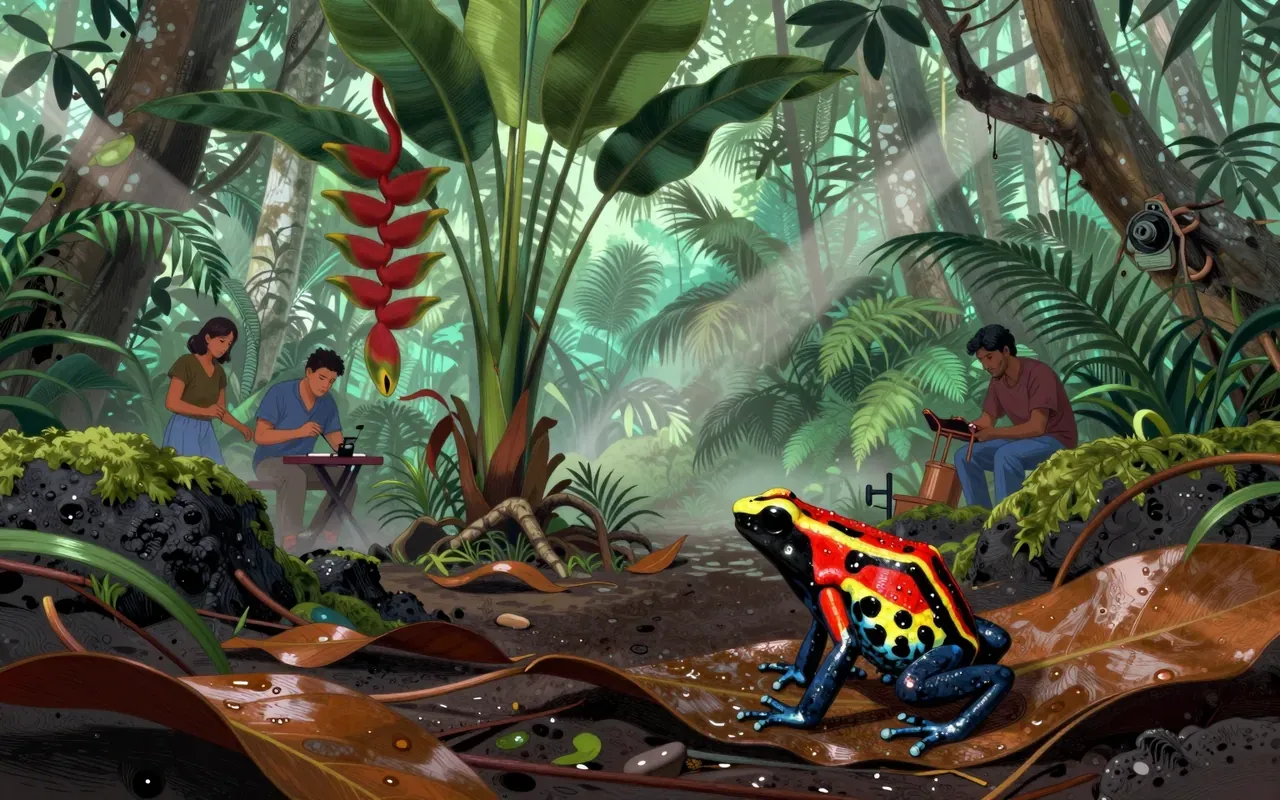
AposematismAposematism is a functional, empirically tested strategy — not metaphor, not speculation. It is defined by honesty, observability, and consequence.
9:44
Attacus atlasAttacus atlas is a large, non-feeding, short-lived saturniid moth endemic to Asian forests. Its most distinctive trait is a defensive wing movement mimicking a snake’s head. Verified claims cover taxonomy, morphology, development stages, diet and habitat—but nothing about conservation impact, longevity beyond 1–2 weeks, or ecological function beyond predation avoidance.
Up next in Nature

Wollemia

· 9:49

A tree that survived 200 million years by not changing—and now survives only because we drop fire retardant on it.

9:49