naturebriefs
7:37in productionCh. 1 · Not hibernation. Not rest./ 7:37 · ceiling 15 min
Systems · Evolution

Aestivation

Summer dormancy isn’t lazy — it’s precision-engineered desiccation defence.

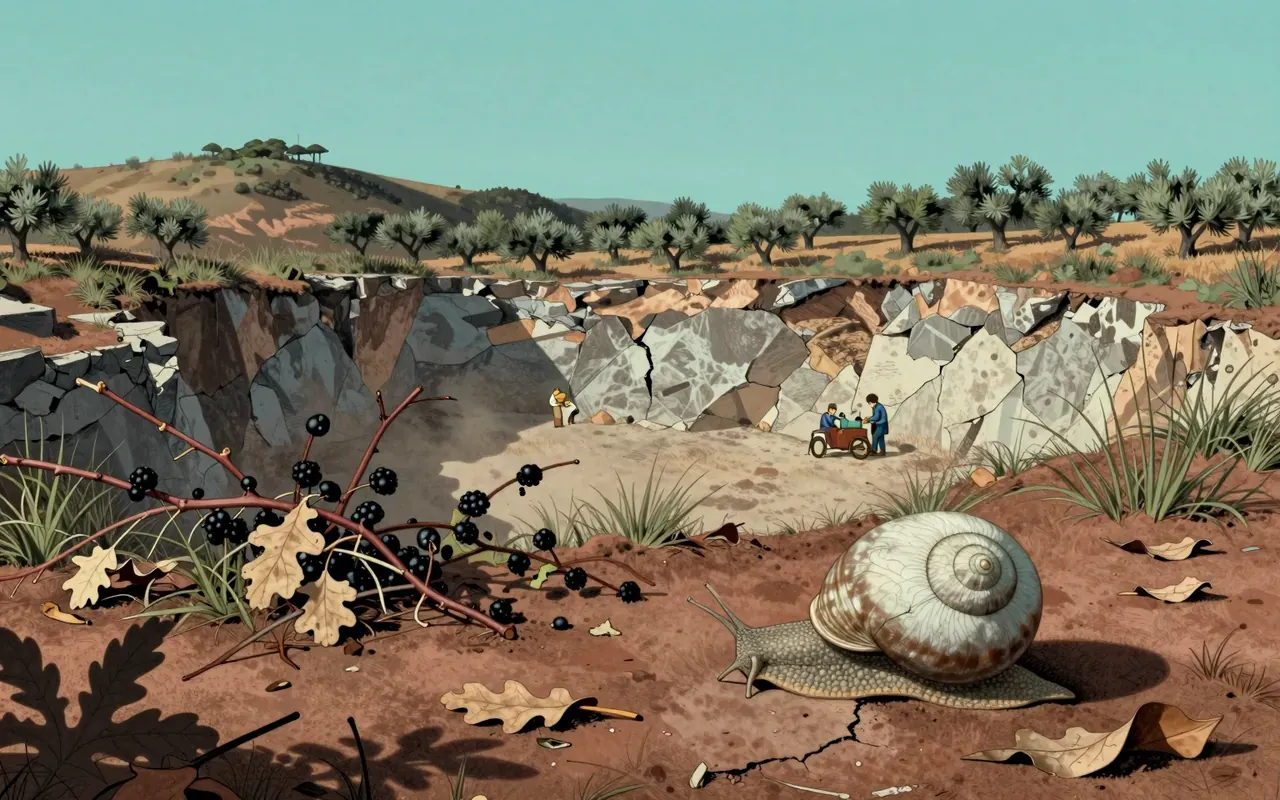
Aestivation is a summer dormancy strategy used by diverse animals and plants to survive high temperatures and arid conditions, involving metabolic depression, water conservation, and macromolecular stabilization; it occurs across terrestrial and aquatic habitats, especially in Mediterranean climates, and is phylogenetically widespread — from snails and beetles to frogs, lungfish, and even some mammals like the fat-tailed dwarf lemur.

Chapters & takeaways4
  1. 0:59
    Not hibernation. Not rest.

    Aestivation is summer dormancy — triggered by heat and dryness, not cold.

  2. 2:12
    Four failures it prevents

    It solves four problems at once: water loss, energy drain, toxic waste buildup, and cellular decay.

  3. 3:25
    Convergent, not inherited

    Cyclamen, frogs, and fat-tailed dwarf lemurs all do it — but none share the trait by descent.

  4. 5:00
    Ancient and light

    Fossil evidence suggests it predates dinosaurs. Metabolic slowdown halts macromolecule turnover.

Worth your time?

Yes. See the whole thing.

4/ 5
What works
  • defines a clear seasonal trigger
  • names universal physiological demands
  • confirms rapid reversibility
  • links distantly related organisms by function
What does not
  • specify duration
  • name species-specific thresholds
  • describe mortality or recovery behaviour
See it if
  • physiologists
  • arid-zone ecologists
  • conservationists in Mediterranean climates
Skip it if
  • field botanists tracking bloom times
  • urban naturalists
  • birdwatchers
The written brief1 min read

What the species is and where it came from

Aestivation is not a species. It is a convergent physiological strategy. It occurs in terrestrial and aquatic animals — including snails, beetles, frogs, lungfish, and the fat-tailed dwarf lemur — and in plants like Cyclamen.

How it works, in terms someone would actually use

Aestivation is summer dormancy. It switches off metabolism in response to heat and dryness. The animal or plant stops moving, eating, and growing. It seals itself in — in mud, soil, leaf litter, or underground burrows — and waits.

What it gets right

It correctly identifies heat and aridity as the universal triggers. It names water retention, nitrogenous waste handling, and macromolecular stability as core physiological demands. It confirms rapid reversibility — unlike hibernation.

What it does not

It does not specify how long aestivation lasts. It does not name a single species’ trigger threshold, duration, or mortality rate. It does not describe behaviour beyond inactivity and metabolic depression.

What it changed

It reframed dormancy as a summer-adapted strategy, not just a winter one. It revealed shared physiological logic across snails, frogs, lungfish, fat-tailed dwarf lemurs, and Cyclamen — organisms with no recent common ancestor.

Who it is for, and who it is not

It is for ecologists, physiologists, and conservationists working in Mediterranean, arid, or seasonally extreme habitats. It is not for birdwatchers, botanists focused on flowering phenology, or urban naturalists without access to dryland field sites.

Is it worth your time

Yes — if you study survival in extreme heat or drought. No — if you need precise field identification cues, seasonal timing, or species-specific triggers. It is a functional category, not a taxon.
Same habitat · Systems4 of 107
9:29
Autumn leaf colorAutumn leaf colour is a seasonal physiological phenomenon in deciduous trees and shrubs. It occurs in temperate deciduous forests across both hemispheres. Yellow and orange hues come from carotenoids present year-round but masked by chlorophyll. Red and purple hues come from anthocyanins synthesised anew in late summer under bright light and cool temperatures. Carotenoids dominate in 15–30% of tree species; anthocyanins occur in ~10% of temperate species—but up to 70% in northern New England. Chlorophyll degradation involves chlorophyll b reductase and FtsH6 protease. Anthocyanin synthesis serves hypothesised functions including photoprotection and coevolutionary signalling against herbivorous insects.
9:06
Brocken spectreThe Brocken spectre is a human-scale optical illusion — not a species, not a force, not a myth made real. It reveals how vision fails without reference points. It works only when light, position, mist, and droplet uniformity align. It has no lifespan, no range, no diet, no predators — only conditions, observers, and consequences.
9:54
CappadociaCappadocia is a landform defined by Miocene ignimbrites, erosion, and human adaptation—not biology, climate, or ecology. It offers no habitat function beyond its physical structure. Its value lies in legibility: a landscape where eruption, time, and weather leave clear, readable traces.
8:38
Ecosystem engineerA precise, behaviour-first lens for habitat-shaping species — grounded in mechanical action, not metaphor.
Up next in Nature

Everglades

· 10:21

A drowned prairie held together by limestone, water, and decades of argument over what ‘restoration’ really means.

10:21