8:12in productionCh. 1 · Not a Canyon/ 8:12 · ceiling 15 min
Habitats · Systems
Bryce Canyon National Park
1928
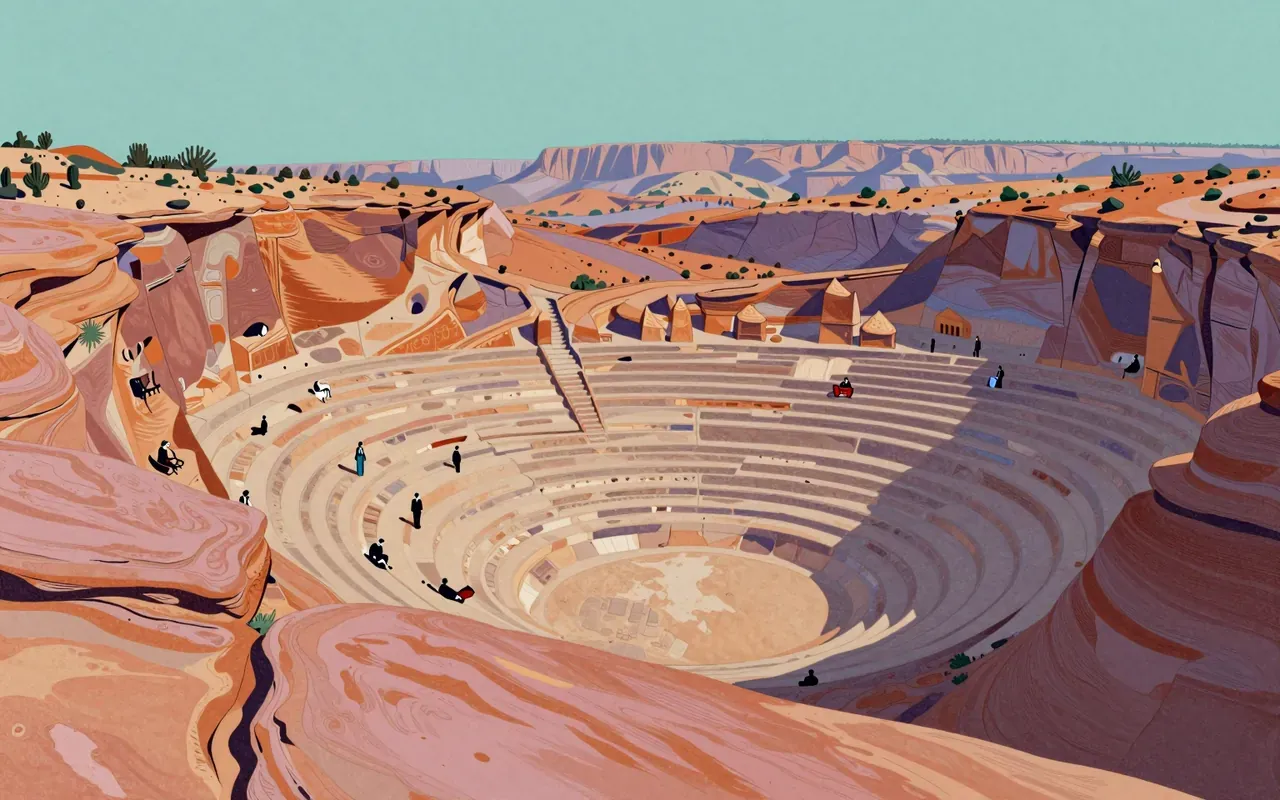
Bryce Canyon isn’t a canyon—it’s a textbook on how frost breaks rock and colour tells geology.
Bryce Canyon National Park (1928) is a U.S. national park in southwestern Utah. It lies on the Paunsaugunt Plateau within the Colorado Plateau. Its defining features are amphitheater-shaped erosional basins—not canyons—and hoodoos formed by frost weathering and stream erosion of Cenozoic sedimentary rock. Colours derive from hematite (orange), limonite (yellow), and pyrolusite (purple). It experiences a Dsb continental climate. Elevations range from 6,620 to 9,105 feet.
It is not a canyon because no central stream carved it.
2:40
Amphitheaters, Not Canyons
Amphitheaters formed by headward erosion—not downward cutting.
4:20
How Hoodoos Form
Hoodoos exist because frost pries apart river-and-lake bed rock.
5:28
Why It Glows
Orange, yellow, and purple come from specific iron and manganese oxides.
Worth your time?
Yes. See the whole thing.
4.5/ 5
What works
shows headward erosion in action
makes iron and manganese oxides legible as colour
redefines landform terminology with observable evidence
What does not
form a true canyon
host central-stream erosion
derive colour from organic sources
feature volcanic or metamorphic rock
See it if
people who study frost weathering in situ
those who seek high-elevation amphitheater landscapes
visitors who value mineralogical colour as diagnostic evidence
Skip it if
people expecting river-carved gorges
those looking for dense vegetation or aquatic habitats
visitors prioritising accessibility over elevation gain
The written brief1 min read
What the species is and where it came from
Bryce Canyon National Park is a U.S. national park established in 1928 in southwestern Utah. It is not a canyon but a collection of natural amphitheaters carved into the Paunsaugunt Plateau.
How it works, in terms someone would actually use
Bryce Canyon National Park works as a landscape of erosion-formed amphitheaters, not a canyon. It functions through frost weathering and stream erosion acting on soft sedimentary rock—especially the Claron Formation—on the Paunsaugunt Plateau.
What it gets right
It gets right the visual and geological logic of hoodoo formation: frost wedging cracks the rock, then streams remove debris, exposing pillars with iron- and manganese-derived colours—hematite for orange, limonite for yellow, pyrolusite for purple.
What it does not
It does not function as a true canyon. It does not derive its colours from organic material or volcanic minerals. It does not host active rivers cutting downward through its core.
What it changed
It changed how geologists describe landforms: it redefined ‘canyon’ by showing that amphitheater-shaped features can form without central-stream erosion.
Who it is for, and who it is not
It is for people who walk high-elevation trails to observe erosion in real time. It is not for those seeking waterfalls, deep gorges, or biodiversity hotspots.
Is it worth your time
Yes—if you want to see hoodoos shaped by freeze-thaw cycles and headward erosion in vividly coloured Cenozoic rock. No—if you expect a river-carved canyon or continuous trail systems.