What the species is and where it came from
Ginkgo biloba is the sole surviving species of Ginkgoales, an order that first appeared in the Permian 270 million years ago. Its lineage diverged from other gymnosperms ~325 million years ago — and from cycads, its closest living relatives, in the early Carboniferous.
How it works, in terms someone would actually use
Ginkgo biloba is a gymnosperm — a non-flowering seed plant — and the only living species in the order Ginkgoales, which originated in the Permian.
What it gets right
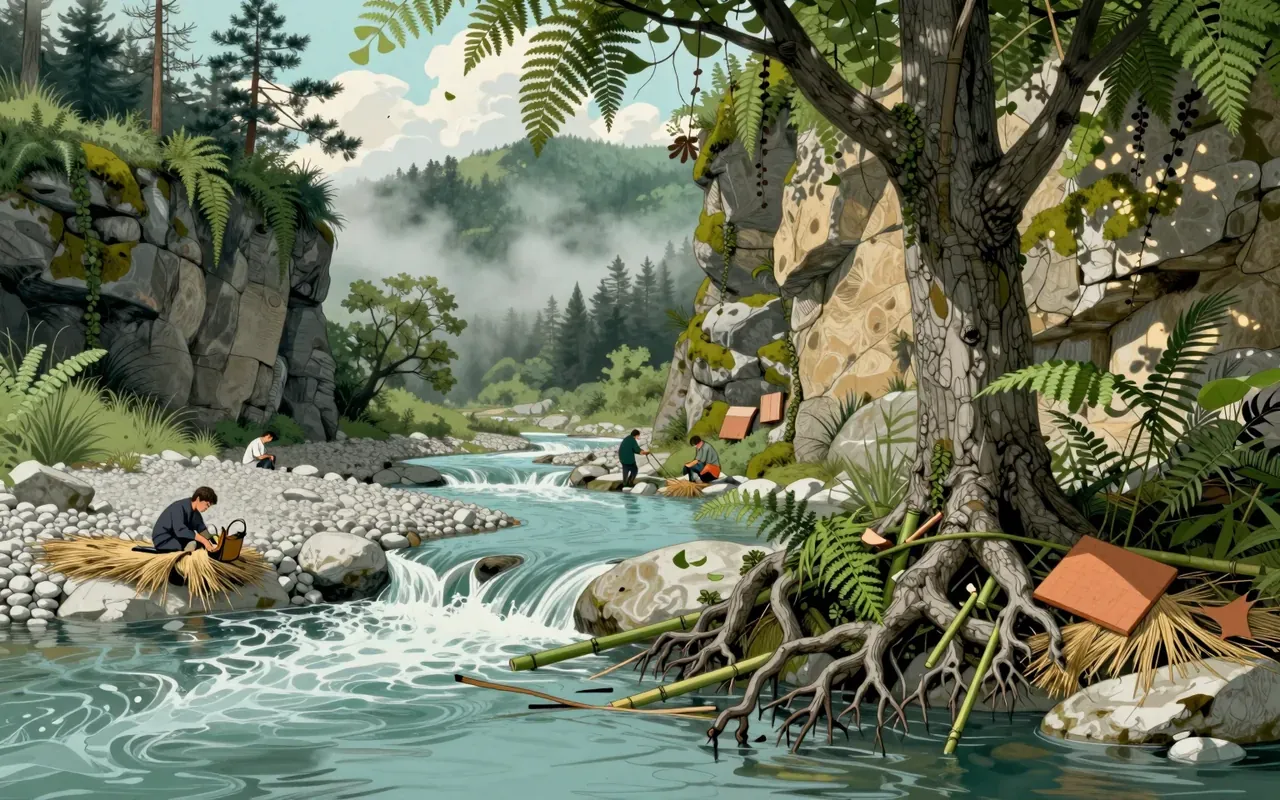
It gets persistence right. It survives where few other ancient lineages do: in flood-scoured, sediment-rich stream margins. Its clonal growth lets it resprout after disturbance — a strategy older than flowers.
What it does not
It does not grow wild outside China. It does not reproduce sexually in most wild stands. It does not occupy stable or mature forest habitats. It does not share recent ancestry with any other living genus except cycads — and that split occurred in the early Carboniferous.
What it changed
It changed nothing. Its evolutionary rate is exceptionally slow. It did not adapt to angiosperm-dominated ecosystems. It clung to pre-angiosperm strategies like clonal reproduction in unstable riparian zones.
Who it is for, and who it is not
It is for field botanists, palaeobotanists, and anyone who walks riverbanks in Zhejiang or Tianmu Shan. It is not for gardeners seeking novelty, nor for conservationists expecting broad ecological function — its wild range is tiny and fragmented.
Is it worth your time
Yes, if you want to see a plant whose wild form has persisted unchanged for 270 million years — but only in China, and only in disturbed streamside habitats.