What the species is and where it came from
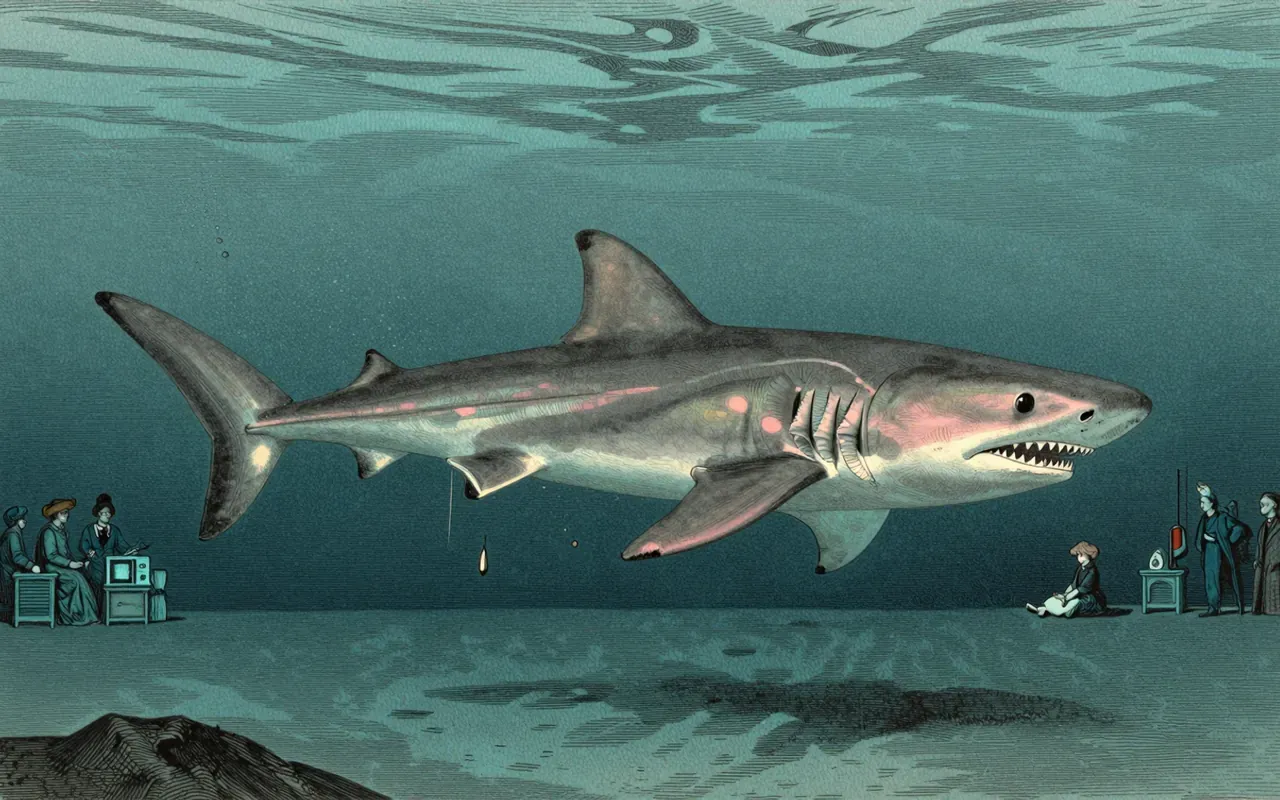
The goblin shark (Mitsukurina owstoni) is a rare, deep-sea, benthopelagic lamniform shark. It is the only living member of the family Mitsukurinidae—a lineage 125 million years old. First described in 1898.
How it works, in terms someone would actually use
It hunts teleosts, cephalopods, and crustaceans near the sea floor and in midwater. It uses electroreception and rapid jaw protrusion to seize prey. Its flabby body and small fins suggest sluggish movement.
What it gets right
It gets deep-sea benthopelagic life right: slow metabolism, sensory specialisation for darkness, and morphological conservatism across geological time. Its snout houses ampullae of Lorenzini; its jaws protrude faster than any other shark’s.
What it does not
It does not establish dense populations. It does not occupy shallow water. It does not show sustained swimming speed or complex social behaviour. It does not appear in fisheries data beyond rare bycatch.
What it changed
It reframed how paleontologists interpret early lamniform evolution. As the only extant member of Mitsukurinidae, its anatomy anchors fossil calibrations for a lineage spanning the Cretaceous to today.
Who it is for, and who it is not
It is for deep-sea biologists, evolutionary palaeontologists, and submersible operators. It is not for snorkellers, aquarium curators, or coastal conservation planners.
Is it worth your time
Yes—if you want to see a living representative of a 125-million-year-old lineage that operates at 2,000 m depth with jaws that shoot forward like a trap. No—if you expect observable behaviour, frequent sightings, or ecological dominance.