Saved
Fish & sea life · Evolution

Nautilus

They are not survivors—they are holdouts. A 500-million-year pause button, still ticking.

Worth your time?3.5/5Yes.See the whole thing.What works, what does not, who it is for ↓
9:23in productionCh. 1 · The Last Nautiloidea/ 9:23 · ceiling 15 min
4 chapters · 9:23Ceiling 15:00

The brief is written and checked. The video joins this page when it is cut.4 chapters · 1 min read · 9:23 planned

Read the brief

Nautilus is a taxonomic relic—not an ecological actor. Its value lies in its unbroken morphology, not its behaviour or abundance.

Chapters & takeaways4
  1. 1:07
    The Last Nautiloidea

    Nine species. One lineage. Zero evolutionary departures in half a billion years.

  2. 2:37
    Shell as System

    Their shell isn’t pretty—it’s precisely engineered: involute, smooth, sutured, siphuncled.

  3. 4:13
    Dwarf Populations, Deep Slopes

    Size varies: 10–25 cm overall, but N. macromphalus caps at 16 cm and Sulu Sea dwarfs average 11.56 cm.

  4. 5:42
    Paper Protection

    All nine species are on CITES Appendix II—protected, but not prohibited from trade.

1 more chapterFewer chapters
Worth your time?

Yes. See the whole thing.

3.5/ 5
What works
  • shell architecture
  • buoyancy control
  • long-term morphological stability
What does not
  • migrate
  • school
  • hunt live prey aggressively
  • change colour
See it if
  • marine palaeontologists
  • CITES field officers
  • shell morphologists
Skip it if
  • fisheries managers
  • ecotourism operators
  • conservation educators
Who should see it, and who should skipHide who it is for
The written brief1 min read

What the species is and where it came from

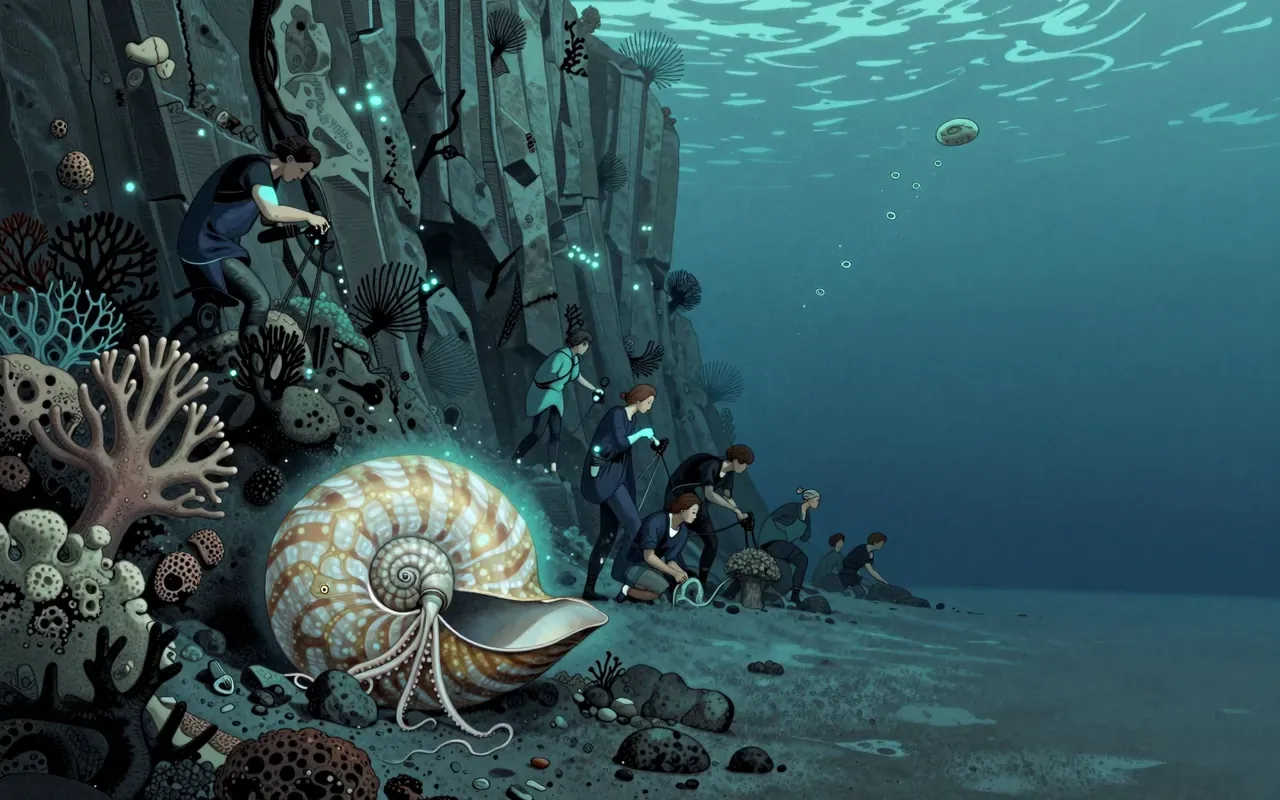
Nautilus is a genus of nine living cephalopod species in two genera, found only on deep coral reef slopes across the Indo-Pacific. It is the sole surviving lineage of the subclass Nautiloidea.

How it works, in terms someone would actually use

Nautiluses move by jet propulsion, expelling water through a siphon. Their shell is buoyant and chambered, with a central siphuncle regulating gas and fluid. They live at depths of 100–500 m on coral reef slopes.

What it gets right

Nautiluses get shell architecture right: logarithmic spiral, involute whorls, smooth surface, straight-to-sinuous sutures, central siphuncle. This design has sustained them for hundreds of millions of years.

What it does not

Nautiluses do not migrate. They do not school. They do not build structures. They do not change colour. They do not hunt live prey aggressively. They do not have arms with suckers.

What it changed

Nautiluses changed nothing in modern ecosystems. They occupy a narrow, static niche. Their evolutionary stasis means they did not drive innovation in cephalopod form or function.

Who it is for, and who it is not

It is for marine palaeontologists, CITES field officers, shell morphologists, and deep-reef surveyors. It is not for fisheries managers, ecotourism operators, or conservation educators focused on charismatic megafauna.

Is it worth your time

Yes—if you are tracking deep-time biology, CITES enforcement, or shell morphology in situ. No—if you seek behavioural complexity, ecological dominance, or population trends.
Same habitat · Fish & sea life4 of 50
Up next in Nature

New Caledonian crow

· 8:10

It doesn’t just use tools—it reshapes them, recombines them, and passes the designs on.

8:10