The Aldabra giant tortoise is not a relic — it is an active ecosystem architect. Its survival is narrow, specific, and contingent on one place. It does not charm. It does not surprise. It reshapes.
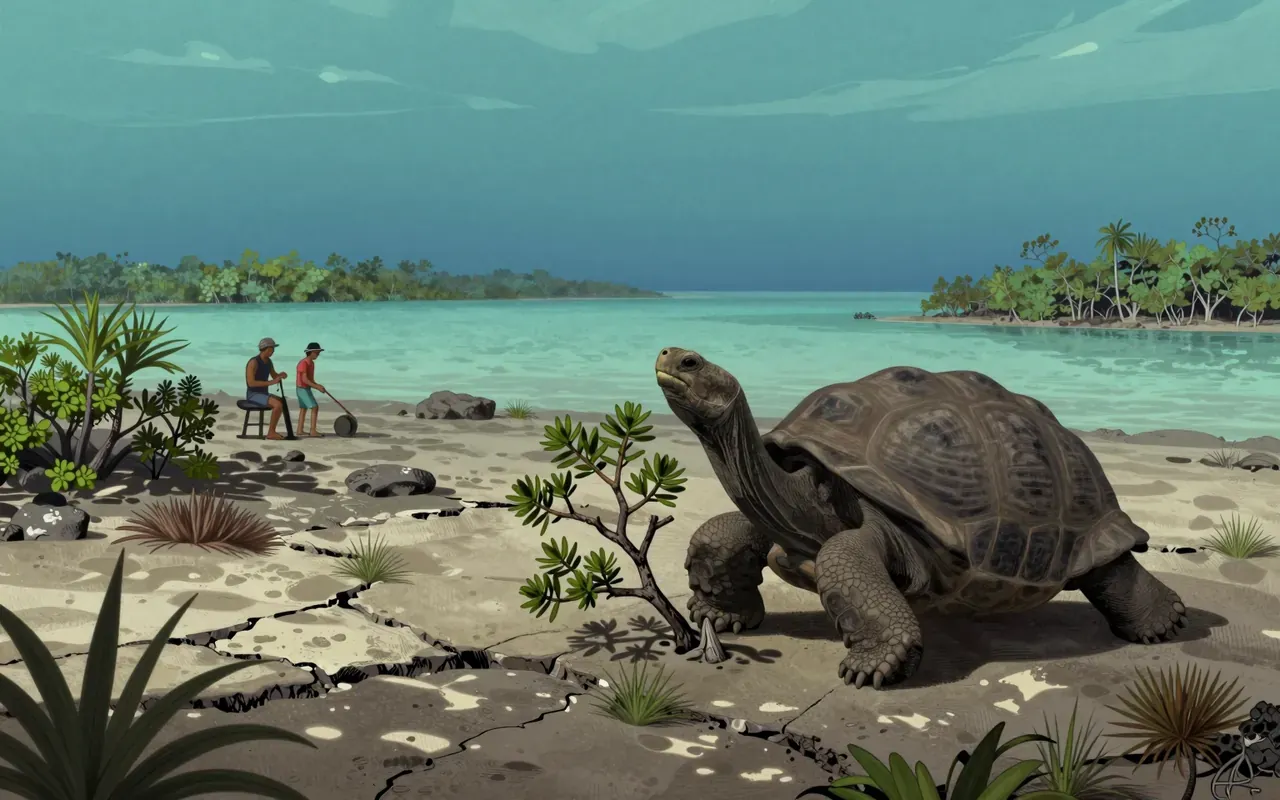
It is the sole surviving giant tortoise of the Indian Ocean, found nowhere but Aldabra Atoll in the Seychelles.
2:19
Shell and neck match the menu
Its shell shape and neck length are direct adaptations to local food height — not generalised traits.
3:34
Island engineer
It engineers habitat like an elephant — felling trees and carving trails used by other animals.
4:42
Last of its kind
Every other Indian Ocean giant tortoise vanished by 1840; this one persisted only because Aldabra stayed remote and protected.
5:51
Ancient split
It split from a Madagascar relative 4.5 million years ago — a deep-time divergence visible in its isolation.
6:51
One atoll, one hundred thousand
Aldabra hosts ~100,000 individuals — the world’s largest and only self-sustaining population.
3 more chaptersFewer chapters
Worth your time?
Yes. See the whole thing.
4.5/ 5
What works
maintains island-wide vegetation structure
creates animal movement corridors
demonstrates morphological adaptation in real time
What does not
survive outside protected habitat
exhibit novel behaviour beyond feeding and movement
interact meaningfully with humans
See it if
field ecologists
conservation practitioners
evolutionary biologists
Skip it if
casual wildlife tourists seeking spectacle
children expecting animated interaction
photographers needing dynamic poses
Who should see it, and who should skipHide who it is for
The written brief1 min read
What the species is and where it came from
It is Aldabrachelys gigantea, a Testudinidae tortoise endemic to the Seychelles, with the nominate subspecies native only to Aldabra Atoll.
How it works, in terms someone would actually use
It feeds on vegetation up to one metre high using its long neck. Its shell shape matches its feeding zone: dome-shaped for ground-level food, flattened with raised front for elevated food.
What it gets right
It gets right the ecological role of a megaherbivore: shaping plant communities, opening space, and enabling other species’ movement.
What it does not
It does not survive outside protected habitat. All other Indian Ocean giant tortoises were extinct by 1840.
What it changed
It changed Aldabra’s vegetation structure and animal movement patterns by felling trees and creating pathways.
Who it is for, and who it is not
It is for people who want to observe evolutionary continuity and functional ecology — not for those seeking behavioural novelty or human-scale interaction.
Is it worth your time
Yes — if you want to see a living analogue of elephant ecology in action, on an atoll where no other large herbivore remains.