naturebriefs
9:02in productionCh. 1 · Where it belongs/ 9:02 · ceiling 15 min
Fish & sea life · Migration

Atlantic salmon

It navigates oceans with iron in its ear — then fails 5% of the time.

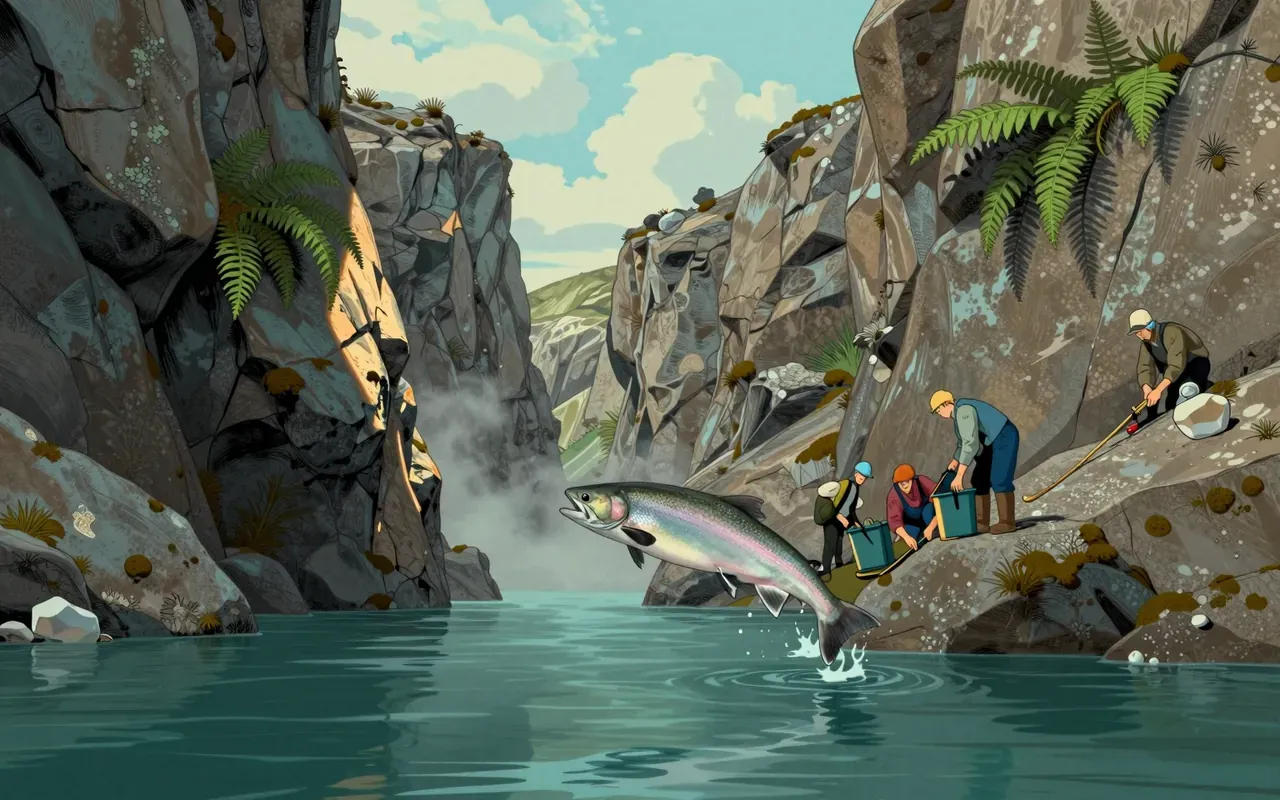
Atlantic salmon is a near threatened, anadromous fish native to the northern Atlantic Ocean and its tributary rivers. Most populations hatch in freshwater, migrate to sea to mature, then return to spawn in gravel redds. Unlike Pacific salmon, it is iteroparous: 5–10% survive spawning and return to sea. Smoltification triggers a behavioural shift from swimming against to with the current, and enables osmotic adaptation for seawater entry. During marine residence, individuals use iron in the lateral line to sense Earth’s magnetic field and likely rely on olfactory cues — with only 5% error — to locate natal rivers. Adults prefer capelin. The IUCN classifies it as near threatened.

Chapters & takeaways4
  1. 0:57
    Where it belongs

    It is born in rivers, lives at sea, and returns to spawn — but only in the northern Atlantic.

  2. 2:32
    When and how it leaves

    Smolts leave rivers between March and June — and switch from fighting to following the current.

  3. 3:56
    How it finds its way back

    It senses Earth’s magnetic field with iron in its lateral line — and finds home with 95% accuracy.

  4. 5:19
    What it does with its body

    It builds gravel nests to spawn — and up to 10% survive to do it again.

Worth your time?

Yes. See the whole thing.

4.5/ 5
What works
  • natal homing within 5% error
  • osmotic adaptation via smoltification
  • iteroparity in a salmonid
What does not
  • die after spawning
  • home with perfect accuracy
  • spawn in saltwater
See it if
  • people who stand on riverbanks in spring and watch silver shapes pulse upstream
Skip it if
  • those who need certainty
The written brief1 min read

What the species is and where it came from

Atlantic salmon (Salmo salar) is a ray-finned fish native to the northern Atlantic Ocean and its tributary rivers.

How it works, in terms someone would actually use

It hatches in northern Atlantic rivers. It migrates to sea as a smolt between March and June. It swims with the current, not against it. It uses iron in its lateral line to sense Earth’s magnetic field. It returns to its natal river with 5% error — likely guided by smell, though unconfirmed. It spawns in gravel redds.

What it gets right

It gets natal homing right — within 5% error across thousands of kilometres. It gets osmotic adaptation right — smoltification flips its swimming behaviour and prepares it for seawater. It gets iteroparity right — surviving to spawn more than once is rare but real.

What it does not

It does not spawn in saltwater. It does not die after spawning — unlike Pacific salmon. It does not home with 100% accuracy: 5% go up the wrong river. It does not use vision or sound as confirmed homing cues.

What it changed

It reshaped human understanding of animal navigation. Its magnetic sensing and near-perfect homing forced biologists to treat fish as geomagnetically literate agents, not passive drifters.

Who it is for, and who it is not

It is for people who stand on riverbanks in spring and watch silver shapes pulse upstream. It is not for those who need certainty: its presence is seasonal, localised, and declining.

Is it worth your time

Yes — if you want to see an animal that navigates oceans by magnetism and returns within metres of where it hatched. No — if you expect reliable sightings: most adults die after spawning; only 5–10% return to sea.

Same habitat · Fish & sea life4 of 46
10:23
MacrocystisMacrocystis pyrifera is a monospecific brown alga that forms extensive underwater forests on rocky substrata in cool, nutrient-rich waters across the Southern Hemisphere and northeast Pacific. It grows up to 60 cm per day, reaches over 45 m in length, and uses pneumatocysts to maintain canopy structure. It supports biodiversity, alters hydrodynamics, and locally raises pH—but only where temperatures stay below 21 °C and urchin pressure remains low. Its taxonomy was consolidated in 2009–2010. Conservation status varies: endangered in Australia, At Risk–Declining in New Zealand.
8:47
OrcaOrca is a cosmopolitan toothed whale—the largest oceanic dolphin—with population-specific diets and intergenerationally transmitted behaviours. Its individual identification via dorsal fin and saddle patch enables precise photographic census. The IUCN lists it as data deficient due to unresolved taxonomic questions. Indigenous peoples in the Pacific Northwest, Australia, and Peru revere it; Western cultures historically feared it.
8:36
TetraodontidaeTetraodontidae is a family of marine and freshwater fish in the order Tetraodontiformes, characterised by four fused beak-like teeth, absence of ribs and pelvic fins, and a specialised defence mechanism involving stomach inflation and dermal spines. Most species are toxic due to tetrodotoxin concentrated in liver and skin, though some — like Sphoeroides maculatus — are nontoxic and consumed as delicacies. They inhabit tropical, temperate, and freshwater ecosystems; diet centres on algae and small invertebrates; and key adaptations include inflation, independent eye movement, colour change, and aposematic colouration.
8:27
Rogue waveRogue waves are transient, non-biological oceanic events—defined, observed, replicated, and hazardous. They do not inhabit, reproduce, migrate, or evolve. They are physics made visible.
Up next in Nature

Axolotl

· 9:08

A salamander that refuses to grow up—and pays for it with near extinction.

9:08