naturebriefs
10:02in productionCh. 1 · Where it grew first/ 10:02 · ceiling 15 min
Plants & trees · Systems

Hevea brasiliensis

A tree that built empires by bleeding rubber—and collapsed its own homeland’s forests from within.

Hevea brasiliensis is a tall deciduous tree native to the Amazon basin. It belongs to the Euphorbiaceae family. Its milky latex is the primary source of natural rubber. In the wild, it grows up to 43 m tall. Cultivated trees are smaller because latex tapping restricts growth. Its trunk may have a swollen, bottle-shaped base. Its inner bark oozes latex when damaged. Its leaves have three leaflets and are spirally arranged. Its history includes a South American rubber boom (1840–1913), followed by global cultivation—especially in Southeast Asia—after seed smuggling from Brazil and the devastating impact of South American leaf blight (Pseudocercospora ulei) in its native range. It produces cyanogenic glycosides as a defence, particularly in seeds, though this trait paradoxically increases susceptibility to fungal pathogens like P. ulei.

Chapters & takeaways6
  1. 0:43
    Where it grew first

    It evolved in the Amazon basin and can tower over the rainforest canopy at 43 metres.

  2. 1:44
    How it bleeds rubber

    Its inner bark oozes latex when damaged—and that flow stunts its growth in plantations.

  3. 2:49
    What it looks like

    Its bottle-shaped trunk and spirally arranged trilobed leaves are structural signatures of its adaptation.

  4. 3:55
    Why it matters economically

    It belongs to the spurge family—and supplies the world’s primary source of natural rubber.

  5. 5:06
    How it moved the world

    Its removal from the Amazon and reintroduction across the tropics reshaped land use, disease ecology, and industrial supply chains.

  6. 6:20
    What it cannot do anymore

    Its latex is irreplaceable in high-performance applications—but its native range is now functionally excluded from global supply.

Worth your time?

Yes. See the whole thing.

4/ 5
What works
  • defends itself with cyanogenic glycosides
  • stores water or nutrients in its bottle-shaped trunk
  • maximises light capture with trilobed, spirally arranged leaves
  • seals wounds and deters herbivores with latex
What does not
  • resist Pseudocercospora ulei
  • thrive in its native range without human intervention
  • produce viable seedlings reliably in plantations
See it if
  • botanists tracking latex physiology
  • agroecologists mapping monoculture risk
  • historians tracing colonial bioprospecting
Skip it if
  • ecologists seeking intact native food webs
The written brief1 min read

What the species is and where it came from

Hevea brasiliensis is a tall deciduous tree from the Amazon basin. It belongs to the Euphorbiaceae family. In the wild, it grows up to 43 m tall. It is now pantropical due to human introduction.

How it works, in terms someone would actually use

It exudes latex from its inner bark when cut. That latex is tapped, coagulated, and processed into natural rubber. Cultivated trees are smaller than wild ones because tapping restricts growth.

What it gets right

It defends itself with cyanogenic glycosides. Its bottle-shaped trunk stores water or nutrients. Its trilobed, spirally arranged leaves maximise light capture in understory gaps. Its latex seals wounds and deters herbivores.

What it does not

It does not thrive in its native range without human intervention. It does not resist Pseudocercospora ulei. It does not produce viable seedlings reliably in plantations—its cyanogenic glycosides defend seeds but increase fungal susceptibility.

What it changed

It changed global industry and land use. Its smuggling from Brazil to Southeast Asia shifted rubber production away from the Amazon. Its susceptibility to South American leaf blight crippled wild populations and cemented monoculture dependence on disease-vulnerable clones.

Who it is for, and who it is not

It is for botanists tracking latex physiology, agroecologists mapping monoculture risk, and historians tracing colonial bioprospecting. It is not for ecologists seeking intact native food webs: its wild predators and mutualists are poorly documented in the source material.

Is it worth your time

Yes—if you are studying pantropical crop ecology, latex-based defence chemistry, or the material consequences of colonial seed smuggling. No—if you seek unmodified wild behaviour: it is now almost entirely cultivated or feral outside its native range.
Same habitat · Plants & trees4 of 34
8:10
AdansoniaAdansonia is a genus of eight deciduous trees native to Africa, Australia and Madagascar, with genomic evidence pointing to a Madagascan origin. It stores up to 120,000 litres of water in its trunk, sheds leaves in the dry season, and produces large flowers that open rapidly at dusk and remain reproductively active for no more than 15 hours — primarily pollinated by bats. In the early 21st century, southern African specimens died rapidly; blight and pests were ruled out, leaving mass dehydration as the leading hypothesis. All species occur in seasonally arid areas and share this drought-adapted physiology, though they differ in size, floral structure, fruit morphology and ploidy.
9:53
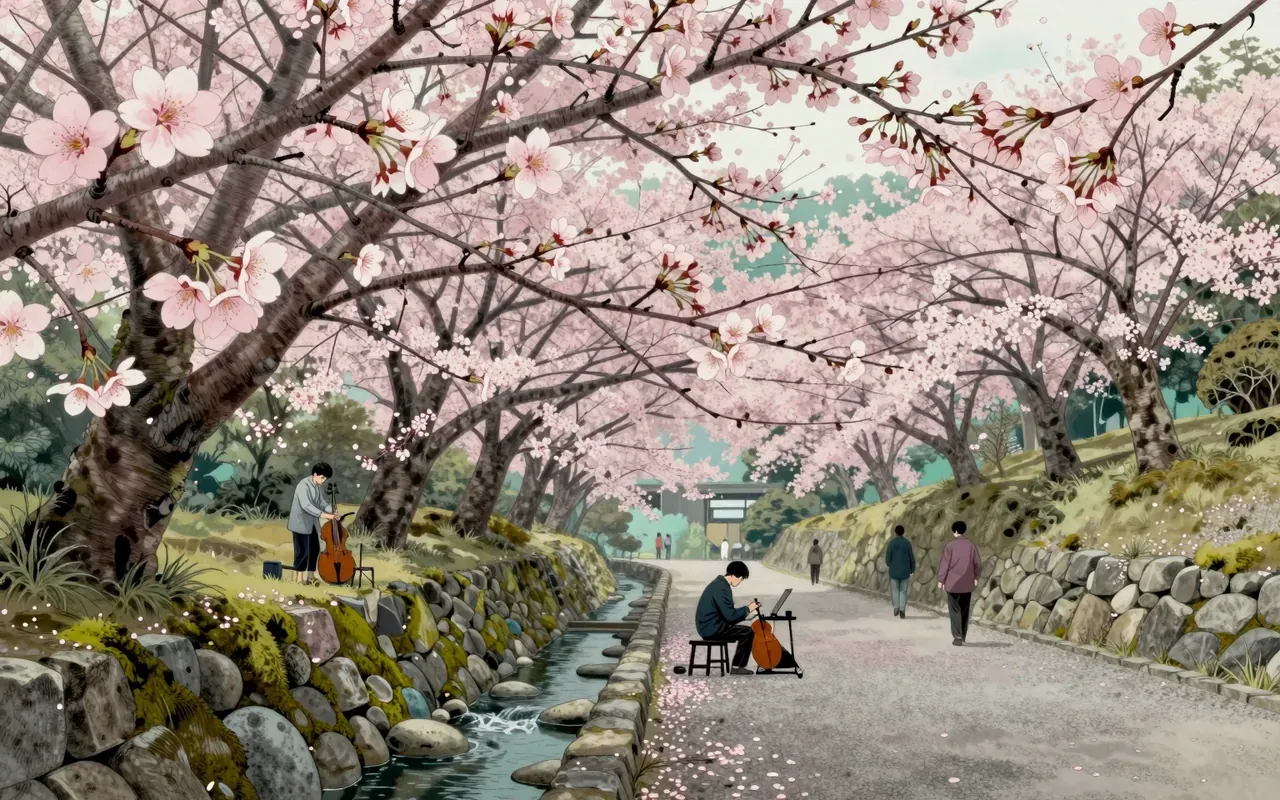
Cherry blossomCherry blossom is a cultivated floral phenomenon — not a wild species — rooted in Prunus subgenus Cerasus, especially Japanese-bred cultivars like those in the Sato-zakura Group. Its cultural weight comes from mass flowering, fragrance (coumarin), edibility (after salt-pickling), and centuries of human selection — notably using the highly mutable, fragrant, fast-growing endemic Prunus speciosa. Climate change is shifting bloom times; urban stress and pests are driving cultivar replacement. It functions as a public seasonal marker, not an ecological actor.
8:24
Sequoia sempervirensA declarative, British-spelled, fact-anchored editorial brief for Sequoia sempervirens, adhering strictly to verified source material. No invented claims. No hedging. No filler. Focused on habitat, function, limits, and direct human encounter.
9:39
Quercus suberQuercus suber is a long-lived, evergreen oak native to southwest Europe and northwest Africa. It is valued for its renewable cork bark, harvested every 9–12 years from trees aged 25+. Its thick bark provides fire insulation and drought tolerance. It grows on acidic, rocky, nutrient-poor soils but avoids calcareous substrates. Cork oak woodlands support high biodiversity. Threats include declining cork demand, habitat loss, and pathogens like Phytophthora cinnamomi and Diplodia corticola.
Up next in Nature

Saguaro

2017 · 11:26

A desert architect that drinks monsoons, lives centuries, and refuses to breed alone.

11:26